How to Verify a Contractor's License and Insurance Before You Hire

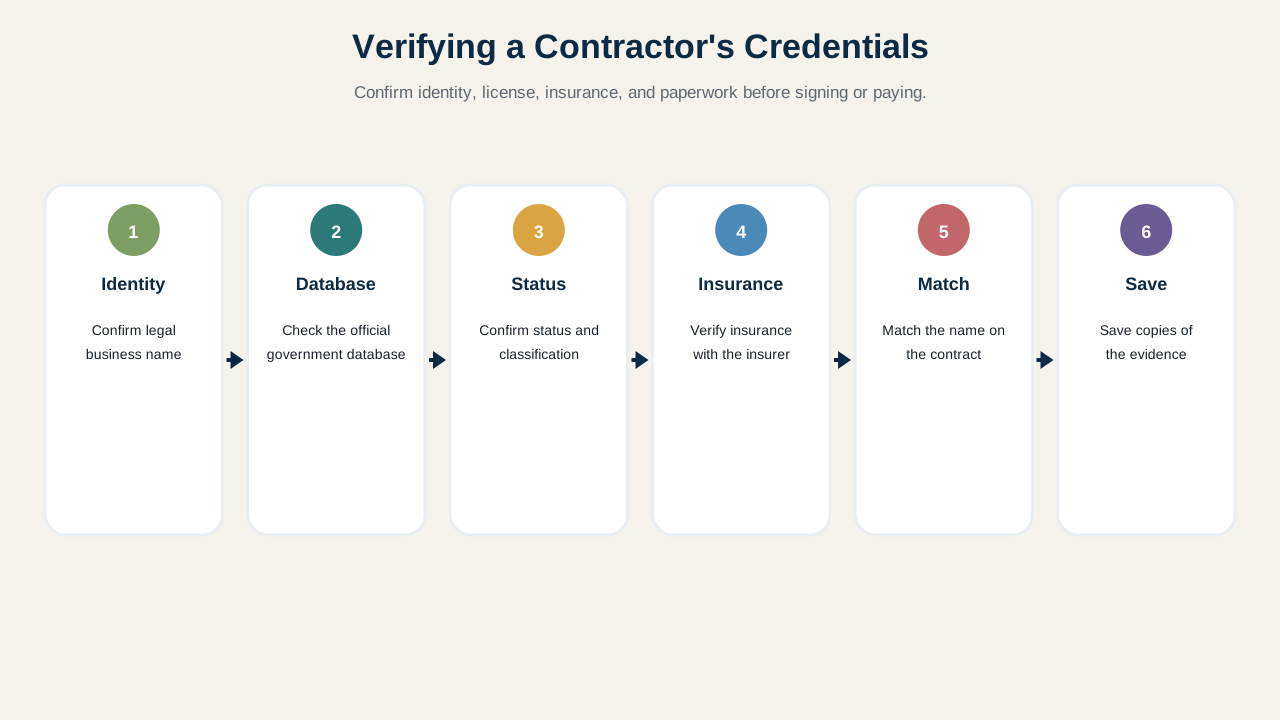
Confirm the contractor's legal business name and identity, look them up directly in your own state or city's official licensing database rather than relying on a screenshot they provide, check that the license status and classification match the work being done, ask for a certificate of insurance naming you as certificate holder and verify it with the insurer, and keep this evidence on file before signing a contract or paying any money -- and remember that licensing, insurance, bonding, and permit rules are set locally and vary by jurisdiction.
Hiring an unlicensed or uninsured contractor is one of the most common ways homeowners end up with an expensive, unresolved problem.
The FTC’s consumer guidance is direct about this: check a contractor’s license with your state or county government, and ask for proof of insurance, before you hire. That verification step should happen before money changes hands, not after a problem appears.
This guide walks through the practical process: confirming legal identity, using the correct official database for your jurisdiction, checking status and classification, verifying insurance, and keeping the evidence, all while recognizing that the specific rules are set locally and vary from state to state and city to city.
The short answer
- Get the contractor’s full legal business name, not just a trade or marketing name.
- Confirm which government agency licenses contractors in your state or city.
- Look the contractor up directly in that agency’s official database. Do not rely on a screenshot or document they hand you.
- Confirm the license is active, not expired, suspended, or revoked.
- Confirm the license classification matches the type of work being done.
- Ask for a certificate of insurance and verify it independently with the insurer.
- Understand that liability insurance and workers’ compensation are different coverages.
- Recognize that license, insurance, bond, and permit are four separate concepts, not one.
- Make sure the name on the contract matches the verified legal business identity.
- Save copies of everything you verified before signing or paying anything.
Licensing Is Jurisdiction-Specific
There is no single national contractor license. Licensing is handled at the state level in most of the country, and some cities add their own additional layer: California’s CSLB, Massachusetts’s Home Improvement Contractor program, and New York City’s Department of Buildings licensing rules are each administered separately, with different requirements.
Do not assume that a rule you read about one state applies elsewhere. Start by confirming which agency actually licenses the type of work you need done in your specific state and city.
Start With the Legal Business Identity
Ask for the contractor’s full legal business name, not just the name on their truck or website. Many contracting businesses operate under a trade name that differs from their registered legal name, and licensing records are typically indexed to the legal name or license number, not the marketing name.
Getting this right at the start avoids searching the wrong record or being shown someone else’s license by mistake.
Use the Official Government Database
The core of verification is checking the license yourself, directly through the government agency’s own website, rather than trusting a document, card, or screenshot the contractor provides. California’s CSLB, for example, offers a public online license-check tool for exactly this purpose.
The FTC’s guidance is consistent with this approach: verify with the state or county government directly. A contractor who has nothing to hide should have no objection to you checking independently.
Confirm More Than “A Record Exists”
Finding a license number in the database is only the first step. Confirm that the license is currently active rather than expired, suspended, or revoked, that the name matches the business you are hiring, and that any disciplinary history disclosed by the database does not raise concerns.
A record that technically exists is not the same as a license in good standing.
Classification Matters
Many licensing systems classify contractors by the type of work they are authorized to perform: general building, electrical, plumbing, roofing, and other specialty classifications are common examples, though the exact categories vary by state.
Confirm that the classification covers the actual work being done. A contractor licensed for one type of work is not automatically qualified or authorized for a different specialty, even if they are willing to take the job.
Ask for Proof of Insurance
The FTC recommends asking for proof of insurance alongside license verification. At minimum, this typically means general liability insurance, which can help cover damage to your property caused by the contractor’s work.
Ask for a certificate of insurance directly, and consider asking the insurance company or agent listed on it to confirm the policy is active, rather than relying solely on the document itself.
A Certificate of Insurance Is Evidence, Not the Final Word
A certificate of insurance is a useful piece of evidence, but it reflects a policy status at a point in time and can be canceled or lapse afterward. Independently confirming with the insurer, and checking the policy dates against your project timeline, adds a meaningful layer of verification.
Do not treat a certificate alone as a permanent guarantee that coverage will still be active when work actually happens, especially for projects scheduled well in advance.
Workers’ Compensation Is Not the Same as Liability Insurance
General liability insurance and workers’ compensation insurance cover different things. Liability insurance generally relates to property damage or injury the contractor’s work may cause; workers’ compensation generally relates to injuries to the contractor’s own employees while working on your property.
Requirements for workers’ compensation vary by jurisdiction and by business size or structure. Do not assume one type of coverage automatically implies the other is also in place.
License, Insurance, Bond, and Permit Are Different
These four concepts are often confused, but they serve different purposes. A license authorizes someone to perform certain work. Insurance covers certain damages or injuries. A bond is a separate financial guarantee that may provide limited recourse in specific situations, where required. A permit is government authorization for a specific project, separate from the contractor’s own credentials.
Having one of these does not mean the others are automatically in place. Confirm each one relevant to your project separately. Our guide to checking whether your project needs a permit covers that layer specifically.
Check the Contract Name
Before signing, confirm that the legal business name on the contract matches the name you verified in the licensing database and on the insurance certificate. A mismatch is worth asking about directly before proceeding.
This is a simple check that catches situations where the entity actually signing the contract is not the same entity whose license and insurance you verified.
What About Subcontractors?
If the contractor you hire plans to use subcontractors, ask whether those subcontractors carry their own appropriate licensing and insurance, or whether they are covered under the general contractor’s policies, depending on how your jurisdiction and the specific project structure work.
Do not assume subcontractor coverage automatically mirrors the general contractor’s. This is worth asking about directly rather than assuming.
Complaints and Discipline
Many official licensing databases disclose complaint history or disciplinary actions alongside license status. Where this information is available, review it as part of your verification, understanding that the presence of a complaint does not automatically disqualify a contractor, but a pattern of unresolved serious issues is worth taking seriously.
A Credential-Verification Table
| What you check | Where to check it | What a red flag looks like |
|---|---|---|
| License exists | Official state/city database | No record found for the name/number given |
| License status | Official state/city database | Expired, suspended, or revoked |
| Classification | Official state/city database | Classification does not cover the work |
| Business legal name | License record and contract | Contract name does not match license |
| General liability insurance | Certificate of insurance, verified with insurer | Certificate cannot be verified or is expired |
| Workers’ compensation | Certificate of insurance or state requirement | Required coverage is missing where applicable |
| Bond (if applicable) | State licensing record | Required bond not on file |
| Complaint/discipline history | Official state/city database | Pattern of unresolved serious complaints |
Red Flags
Be cautious of a contractor who resists direct verification, provides only a screenshot instead of allowing you to check independently, pressures you to sign quickly, asks for full payment upfront, cannot produce a legal business name, offers a license number that does not match their name in the database, avoids written contracts, appears only after a storm or disaster soliciting door-to-door, has a pattern of unresolved complaints, or asks you to pull the permit yourself for work that should be under their responsibility.
The FTC’s guidance on post-disaster scams specifically flags high-pressure, door-to-door solicitation after severe weather as a common pattern worth extra caution.
Save the Evidence
Keep copies of the license verification, the certificate of insurance, the signed contract, and any correspondence. If a dispute arises later, this record is what allows you to show what you verified and when.
How This Fits With the Other Contractor Guides
This article focuses specifically on license and insurance verification. For the broader hiring process, see our guide to hiring a home improvement contractor. Once you have a shortlist of verified contractors, our guide to comparing contractor estimates covers how to evaluate bids side by side. And before work begins, check whether your specific project needs a permit, since permitting is a separate layer from the contractor’s own license.
Verify Before Money Changes Hands
License and insurance verification takes a small amount of time compared to the cost of hiring the wrong contractor. Confirm identity, check the official government database yourself, verify insurance independently, and keep the paperwork, then move forward with confidence.
When the scope, cost, or risk of a project makes you uncertain whether to do it yourself or hire out, our guide to DIY or hire a professional can help frame that decision before you get to the verification stage at all.
Sources and further reading
We prioritize primary and authoritative sources. The sources below support the factual and technical guidance used in this article.
- Federal Trade Commission: How To Avoid a Home Improvement Scam
- Federal Trade Commission: How To Avoid Scams After Weather Emergencies and Natural Disasters
- California Contractors State License Board: Check a License
- California Contractors State License Board: Finding the Right Licensed Contractor
- Commonwealth of Massachusetts: HIC Homeowner Resources
- NYC Department of Buildings: Licensing FAQ
Practical Homeownership provides general educational guidance. Home conditions, local rules, manufacturer requirements, and the appropriate professional scope can vary.