How to Compare Contractor Estimates: Make the Bids Comparable Before You Choose

Before comparing totals, make sure every bid is pricing the same problem statement, then compare scope, materials and allowances, listed exclusions, permit responsibility, timeline, and payment structure line by line; don't automatically choose the lowest bid, and ask each contractor to explain large differences before deciding.
Three contractor estimates can look like three prices for the same job. Often they aren’t. One bid might include permits, disposal, premium materials, and finish work. Another might leave some of those items out entirely. One contractor may be pricing a complete replacement while another assumes a repair. A low bid can be perfectly legitimate, or it can be low simply because the scope is narrower.
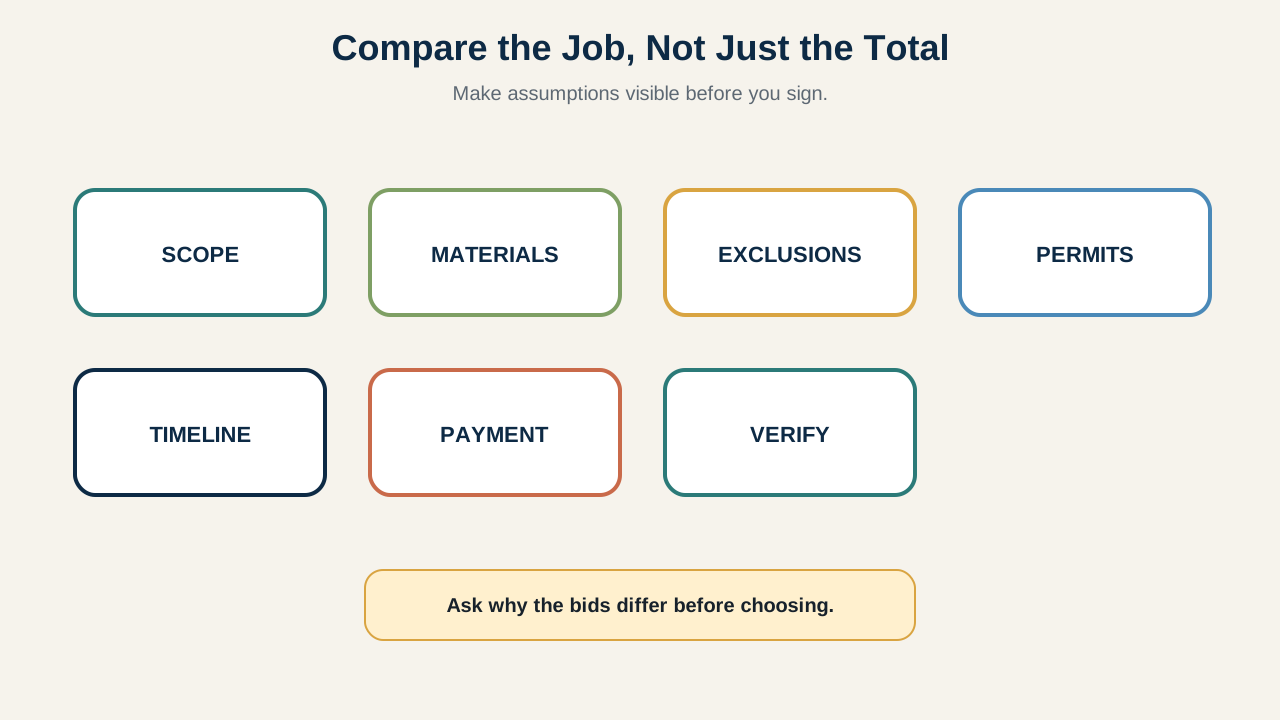
FTC guidance gives homeowners a solid starting point: get multiple written estimates, make sure each one describes the work, materials, completion timing, and price, and don’t automatically choose the lowest bidder. The useful framework is scope, then materials, then exclusions, then permits and responsibility, then timeline, then payment, then contractor verification, and finally the comparison itself.
The goal isn’t to force every contractor to quote the same number. It’s to make sure you understand what each number actually buys.
The short answer
Before selecting a contractor, get multiple written estimates and make the requested scope as consistent as possible across all of them. Compare the work description line by line, and identify material brands, grades, quantities, or allowances where they matter. Ask what’s excluded, and clarify who’s responsible for permits, inspections, disposal, cleanup, and protection of the work area. Compare start and completion expectations, not just a single completion date, and review the proposed payment structure.
Verify the licensing and insurance that apply in your jurisdiction, and ask about large price differences instead of assuming the cheapest or most expensive estimate is automatically correct. FTC specifically advises homeowners not to automatically choose the lowest bidder, and to ask for an explanation when estimates differ substantially.
Start With the Same Problem Statement
If three contractors are effectively solving three different problems, the estimates you get back won’t be comparable no matter how carefully you read them. Before requesting bids, write a short project description: something like “replace damaged exterior door and repair affected trim,” “repair active leak at a defined plumbing location,” “replace existing water heater with a specified capacity and type subject to local requirements,” or “add attic insulation after required air-sealing and moisture issues are addressed.”
You don’t need to design the contractor’s solution for them. You do need to give every bidder the same observed problem, the same desired outcome, and the same known constraints. Photographs, inspection findings, dimensions, and any known product requirements all help keep the starting point consistent across bids.
Compare Scope Before Price
The first comparison shouldn’t be the total at the bottom of the page. Read what each contractor actually says they’ll do. A useful scope makes clear which components are being repaired, removed, replaced, or left in place: repair versus full replacement, partial-area versus whole-area work, removal of old materials, preparation work, substrate or framing repair, finish work, painting or touch-up, haul-away and disposal, and final cleanup.
A $4,000 bid and a $6,000 bid may not actually be competing prices if the second one includes work the first one excludes entirely.
Materials Need Enough Detail to Compare
FTC says written estimates should include the materials involved. That doesn’t mean every screw needs its own line item, but anything that materially affects performance, appearance, durability, warranty, or cost should be identifiable: manufacturer or product line, model where relevant, material type, grade or thickness, color or finish, quantity, warranty class, and the allowance amount if a final selection hasn’t been made yet.
Watch for vague language like “standard material,” “builder grade,” or “allowance” when the price depends heavily on what that phrase eventually turns out to mean. Ask for clarification before signing, not after installation has already started.
Allowances Can Hide the Real Difference
An allowance is a budget placeholder for something that hasn’t been finally selected. Reasonable enough for tile, fixtures, hardware, or finishes, but it also means two estimates with different allowances aren’t directly comparable. If Contractor A includes a $1,000 flooring allowance and Contractor B includes $3,000, the totals may differ by $2,000 before labor or profit even enters the picture.
Normalize the important allowances before comparing bids. Ask what the allowance covers, whether sales tax and delivery are included, what happens if the final selection costs more or less than the allowance, and whether changing the product would change the labor cost too. The real bid shouldn’t become clear only after the project is already underway.
Ask for the Exclusions
One of the fastest ways to understand a quote is to ask what’s not included. Common exclusions can cover permits, engineering or design, hazardous-material testing or abatement, hidden damage, drywall repair, painting, landscaping restoration, appliance moving, temporary protection, disposal fees, utility work, and code upgrades discovered after an assembly is opened up.
If the home was built before 1978 and the project will disturb painted surfaces, hazardous-material handling isn’t an abstract line item. It’s a specific, named requirement. What to know about lead paint before you renovate explains why a paid contractor doing that kind of work generally has to be Lead-Safe Certified and follow lead-safe work practices, and why one bid quietly assuming that compliance step away can look cheaper than a bid that priced it in correctly.
An exclusion by itself isn’t a problem. Unclear responsibility for it is. If a contractor expects you to arrange part of the work yourself, you want to know that before you compare totals, not after.
Permits and Inspections Need a Named Responsible Party
FTC warns homeowners to be cautious when a contractor asks the homeowner to obtain required building permits directly. Permit rules vary by jurisdiction and project, so the estimate or contract should make clear whether a permit is required, who’s responsible for obtaining it, whether permit fees are included, who coordinates required inspections, and whether corrections required by an inspector are included or billed separately.
Don’t use a general article to guess at local permit law. Verify with the local permitting authority whenever the project may require approval, and see checking whether your repair needs a permit for how to work through that question before you’re comparing bids at all.
Compare Timeline, Not Just Completion Date
FTC recommends that estimates and contracts address timing, and a useful comparison covers more than a single completion date. Clarify the estimated start date, expected project duration, major dependencies, material lead times, whether work will be continuous or intermittent, and what conditions could extend the schedule.
A lower-cost contractor who can’t start for four months may still be the right choice, and a higher-cost contractor who can start tomorrow isn’t automatically the better one. Timing has real value. It just needs to be visible in the comparison rather than hidden inside the price decision.
Payment Structure Is Part of the Estimate
Don’t compare only the total price. Compare when the money is actually due. FTC advises homeowners not to pay the full project amount up front, and notes that some states limit how much a contractor can request as a down payment.
A payment schedule should relate sensibly to the project. Before signing, understand the deposit amount, the milestone payments, what work or materials trigger each payment, the conditions for final payment, and the accepted payment methods. A contractor asking for nearly everything before meaningful work has started creates a very different risk than one using staged payments tied to actual progress. Check the applicable state rules, since some regulate deposits or contract terms directly.
Verify the Contractor Separately From the Price
A good estimate doesn’t by itself prove the contractor is qualified. FTC recommends checking licensing and insurance as applicable and reviewing the contractor before committing to anything. That verification can include the license status through the relevant state or county authority, proof of insurance, business contact information, references where useful, complaint or review history, and confirming that the company name on the estimate actually matches the licensed and insured entity.
Don’t rely solely on a license number printed on a document. Verify it with the issuing authority when licensing applies: the same verification step our contractor-hiring guide covers in more depth.
Do Not Automatically Choose the Lowest Bid
FTC explicitly tells homeowners not to automatically choose the lowest bidder, and that doesn’t mean the lowest bid is bad. It means price needs context. A lower bid may reflect lower overhead, more efficient work, a narrower scope, cheaper materials, fewer included services, or simply a mistake or omission. A higher bid may reflect a more complete scope, different materials, more preparation work, permit or cleanup costs already built in, a longer warranty, or just a higher price with nothing else behind it.
Ask about the differences directly. A credible contractor should be able to explain the assumptions behind their own estimate.
Build an Apples-to-Apples Comparison Table
Before deciding, put the bids into one comparison sheet covering the core scope, material or product, allowances, demolition and removal, disposal and cleanup, permit responsibility, inspection coordination, hidden-condition exclusions, start estimate, duration, deposit, payment milestones, warranty, license verification, insurance verification, and the total.
The point isn’t to generate an automatic score. The table exists to expose why the prices differ in the first place.
Change Orders Need a Process Before Work Starts
Projects sometimes uncover conditions that couldn’t reasonably have been known from the initial inspection. The contract should define how changes get approved rather than relying on an informal “we’ll figure it out.” A practical change-order process should answer who can authorize added work, whether the change has to be written, the price and schedule impact, and what happens before any extra work begins. Don’t let a fixed bid quietly turn into an open-ended project with no documentation behind the changes.
Do Not Leave Blank Spaces in the Contract
FTC specifically advises homeowners to make sure blank spaces are filled in before signing: a simple but important control, since the signed agreement should reflect exactly what you approved. If a term doesn’t apply, mark it accordingly rather than leaving a space that could get filled in later by someone else. Keep copies of the final signed documents, estimates, change orders, receipts, and any communications that affect scope or price.
Financing Can Distort the Comparison
A contractor-arranged monthly payment can make an expensive project look cheaper than it actually is. Compare the project price separately from the financing itself. If financing is involved, review the cash price, the amount financed, the interest rate or APR, fees, term, total of payments, and any security interest or lien implications where applicable.
FTC warns consumers to slow down when a contractor pressures them into financing or uses urgency to push a decision. Don’t let “only $___ per month” replace the actual project-cost comparison.
A Contractor-Estimate Decision Table
| What you find | What it suggests | What to do next |
|---|---|---|
| One bid is much lower | Scope, materials, or assumptions may differ | Ask why before choosing |
| Material descriptions differ | You may not be pricing the same product | Normalize the specifications |
| Large allowances differ | Totals aren’t directly comparable | Compare using the same expected selection |
| Permit responsibility is vague | Cost and legal responsibility are unclear | Clarify with the contractor and local authority |
| Full payment requested upfront | Financial risk is high | Don’t proceed without resolving payment terms |
| Contractor won’t provide a written scope | Comparison and enforcement become difficult | Use a contractor willing to document the job |
| License cannot be verified where required | Qualification or compliance concern | Stop until it’s verified |
| Estimate omits cleanup or disposal | Final cost may rise | Ask whether it’s excluded or included elsewhere |
| Bid includes major work others didn’t mention | Contractors may understand the problem differently | Reconcile scope before comparing price |
| Financing dominates the sales pitch | Monthly payment may hide the total cost | Compare cash and project price first |
Know When the Scope Needs Professional Design First
Some projects shouldn’t go straight from homeowner observation to contractor price-shopping. Structural changes, complex drainage, major electrical work, significant foundation problems, or anything requiring engineering or design may need a defined professional scope before construction bids can be meaningfully compared. Otherwise, each contractor may design a different solution and quote a genuinely different project. In those cases, paying for diagnosis or design up front can make the bidding process both more competitive and easier to evaluate.
Compare the Job, Not Just the Number
A contractor estimate is only useful once you understand what’s behind the total. Use the sequence: same problem statement, scope, materials, exclusions, permits, timeline, payment, verification, then compare, and ask about the differences you find along the way.
The cheapest bid can be the best bid. The highest bid can be the best bid. Neither conclusion follows from the total alone. A good comparison is what makes the hidden assumptions visible before you sign anything, which is really the same judgment our DIY or hire a professional guide asks you to apply earlier in the process: deciding whether the job needs a contractor at all before you start comparing what they’d charge for it. This comparison process is one part of a broader hire or DIY approach to home repairs. Before you normalize the bids, make sure permit assumptions are one of the line items you’re comparing. Checking whether your repair needs a permit explains why one contractor’s low bid can quietly be skipping a step another one priced in. It’s worth doing this verification before you compare a single number: verifying a contractor’s license and insurance before you hire can rule out a bid that looks good only because it’s coming from an unlicensed or uninsured contractor.
Sources and further reading
We prioritize primary and authoritative sources. The sources below support the factual and technical guidance used in this article.
Practical Homeownership provides general educational guidance. Home conditions, local rules, manufacturer requirements, and the appropriate professional scope can vary.