How to Hire a Home Improvement Contractor Without Guessing

Verify the contractor's license and insurance through your state or county, compare multiple written estimates for the same scope of work, put the agreement in writing with no blank spaces, and never pay the full project price up front or make the final payment before the work is complete and you're satisfied.
Hiring a contractor isn’t just a price decision. You’re choosing who gets access to your home, who controls part of the project schedule, who may handle permits or subcontractors, and who’s responsible for work that can be difficult or expensive to correct later.
The Federal Trade Commission’s consumer guidance gives a practical structure: verify the contractor, compare written estimates, read the contract carefully, pay in stages rather than all at once, and watch for pressure tactics. The goal isn’t to eliminate every project risk. It’s to replace guesswork with documentation.
The short answer
Before hiring a home improvement contractor:
- Define the project clearly enough that contractors are bidding on the same work.
- Verify any license required by your state or county and ask for proof of insurance.
- Get multiple written estimates.
- Compare scope, materials, schedule, exclusions, and price, not just the total.
- Put the agreement in writing and fill every blank before signing.
- Understand who will obtain required permits.
- Don’t pay the full project amount up front.
- Don’t make the final payment until the agreed work is complete and you’re satisfied with it.
- Keep copies of estimates, contracts, change orders, receipts, permits, warranties, and communications.
If someone pressures you to sign immediately, wants all the money up front, insists on cash only, offers suspicious financing, or tells you to pull permits that the contractor would normally handle, slow the process down. FTC identifies those as warning signs worth taking seriously.
Start With the Scope, Not the Contractor
The easiest way to get incomparable estimates is to ask different contractors different questions. Before calling anyone, write a short project brief covering what problem you’re trying to solve, which rooms, systems, or surfaces are involved, what you already know about the condition, what outcome you want, any products or materials you specifically want or want to avoid, constraints such as access, timing, occupied rooms, pets, or HOA rules, and whether you expect the contractor to handle permits and inspections.
You don’t need to design the technical solution yourself. You do need enough clarity that one contractor isn’t pricing a patch while another is pricing a full replacement. A detailed scope makes price differences easier to understand.
Verify the Contractor Through the Government Source
FTC advises consumers to consider contractors who are licensed and insured, and to verify a contractor’s license with the relevant state or county government. Licensing rules vary widely by jurisdiction and trade: a person may need a state license, a county or city registration, a specialty trade license, or no contractor license for a particular low-value scope in some places.
Don’t assume that a professional-looking website proves compliance. Use the licensing authority that actually regulates the work where the home is located, and verify the contractor or business name, license number if required, license status, trade classification or scope where applicable, expiration date, and disciplinary information if the agency publishes it. If the name on the estimate doesn’t match the name in the licensing record, ask why before moving forward.
Ask for Proof of Insurance
FTC also recommends asking the contractor for proof of insurance. The exact coverage needed depends on the project, contractor structure, workers involved, and local rules. The homeowner’s task isn’t to become an insurance underwriter. It’s to avoid accepting “yes, we’re insured” as the entire verification process.
Ask for documentation and confirm what it represents. For larger or higher-risk projects, it can be worth contacting the insurer or agent using independently verified contact information if you need to confirm current coverage. Insurance doesn’t guarantee good workmanship; it’s one layer of risk control.
Get Multiple Written Estimates
FTC recommends multiple estimates. A written estimate should describe the work, materials, completion date, and price. That written detail is what lets you compare offers intelligently. A useful estimate may also identify demolition or removal, disposal, preparation work, material brands, grades, or allowances, labor, subcontracted work, permit assumptions, exclusions, cleanup, warranty terms, and payment schedule.
Don’t automatically choose the lowest bid. FTC specifically advises asking for an explanation when estimates differ significantly. A lower number may reflect efficiency, but it may also reflect a smaller scope, cheaper materials, missing disposal, no permit allowance, or an excluded step you assumed was included. The comparison should answer whether these contractors are actually pricing the same job. Once the estimates are in hand, comparing contractor estimates side by side is its own step, worth walking through deliberately rather than eyeballing three total numbers.
Compare the Difference, Not Just the Total
Put the estimates side by side. For each one, mark what’s included, excluded, unclear, an allowance rather than a fixed cost, a homeowner-supplied item, or a contractor-supplied item.
If one bid is much lower, ask what’s different. If one bid is much higher, ask what additional work or material is included. Don’t ask the contractor only to “match the price.” First find out whether the scopes match. A cheap estimate that becomes expensive through change orders isn’t necessarily a better deal than a higher estimate that defined the work correctly at the start.
Check Reputation With a Critical Eye
FTC recommends getting recommendations from people you know and trust, checking consumer-protection sources, and searching for complaints. Online reviews can help, but they aren’t proof by themselves. FTC separately warns consumers to evaluate reviews critically because reviews can be fake, deceptive, or manipulated.
Useful review questions include whether complaints are about the same issue repeated, whether reviewers describe projects similar to yours, whether the business responds professionally to problems, whether there are sudden bursts of vague five-star reviews, and whether the business identity in the reviews matches the legal or licensed business you verified. References can add another layer: for a substantial project, ask whether the contractor can provide recent customers with similar work, subject to customer consent.
Permits Are Part of the Project
Permit requirements are local. They can depend on trade, project value, structural changes, electrical or plumbing work, HVAC work, location, and other factors. Don’t rely on a generic national article to tell you whether your exact project needs a permit. Check with the local building authority.
FTC lists it as a warning sign when a contractor asks the homeowner to get required building permits. That doesn’t mean a homeowner can never legally obtain a permit. Local procedures differ. It means you should understand why the contractor wants you to do it and whether that arrangement matches normal local practice and the contract. Before signing, establish whether a permit is required, who applies for it, whose name appears on it, who schedules inspections, whether permit fees are included, and what happens if an inspection requires correction. That shouldn’t be discovered halfway through the project.
If the Home Was Built Before 1978, Ask About Lead
A permit and a license aren’t the only things worth checking on an older home. If the project will disturb painted surfaces in a house built before 1978 (sanding, cutting, or window replacement are common examples), federal rules generally require a paid contractor to be Lead-Safe Certified and to use lead-safe work practices. What to know about lead paint before you renovate explains that requirement in more depth, including why it applies differently depending on who’s doing the work and why. Ask directly whether the firm is certified for this kind of project before you get to the contract stage, not after.
Read the Contract Before You Sign
FTC advises asking for a written contract even where state law may not require one. Contract rules vary by state, so local requirements still apply. At minimum, FTC says the contract should include identifying information for the contractor, estimated start and completion dates, and promises made about scope and costs.
For a real project, also make sure the agreement clearly captures the terms you care about: exact scope of work, materials or allowances, payment schedule, change-order process, permit responsibility, cleanup, access to the home, working hours, subcontractor responsibilities, warranty terms, and how disputes or unfinished items are handled.
Don’t sign a contract with blank spaces. FTC explicitly warns consumers to make sure blanks are filled in. If a verbal promise matters to your decision, put it in the written agreement.
Treat Change Orders as New Decisions
Home projects change. Hidden damage may appear, a product may be unavailable, or the homeowner may add work. The safe response isn’t to pretend changes never happen. It’s to document them.
Before extra work begins, a change order should make clear what’s changing, why, added or reduced cost, schedule effect, materials involved, and whether another permit or inspection is required. Don’t rely on a chain of casual text messages for major changes if the contract has a formal change-order process. The documentation protects both sides by reducing memory disputes later.
Don’t Pay the Whole Project Up Front
FTC advises consumers not to pay the full amount for a home improvement project up front. Some states limit how much a contractor can request as a down payment. Check your state or local consumer agency for rules where you live.
A payment schedule should correspond to the project in a way you understand. Payments may be tied to documented milestones, delivery of major materials, or completion stages, and the exact structure varies by project. The important principle is that the contractor shouldn’t already have 100 percent of the money while substantial contracted work remains incomplete.
FTC also advises not making the final payment until the work is complete and you’re satisfied with it. Before final payment, confirm any required final inspections, punch-list items, documents, warranties, and agreed cleanup.
Be Careful With Contractor-Arranged Financing
FTC warns about home-improvement loan scams in which a contractor steers the homeowner to a lender and the homeowner signs financing documents without fully understanding the terms. Don’t treat financing as a convenience add-on to the construction contract. Treat it as a separate financial decision.
Compare alternatives, read every document, and understand the interest rate, fees, payment amount, term, whether the loan is secured by the home, consequences of default, and whether the contractor is paid before the work is complete. Never sign blank loan papers or documents you haven’t read. Pressure to “sign now so we can lock the deal” is a reason to slow down, not speed up.
Know When the FTC Cooling-Off Rule May Apply
The FTC Cooling-Off Rule gives consumers three business days to cancel certain sales made at a home, workplace, dormitory, or a seller’s temporary location. It doesn’t apply to every contractor transaction, and the rule has exceptions. Don’t assume every home improvement contract comes with an automatic three-day federal cancellation right.
If the sale was made in a covered setting, review the FTC’s current Cooling-Off Rule guidance and any state cancellation rights before relying on them. FTC’s home-improvement guidance also advises checking that applicable cancellation information is included in the contract when required. The broader lesson is simple: know the cancellation terms before signing, not afterward.
Red Flags Worth Slowing Down For
FTC identifies several common home-improvement scam tactics. Be cautious when someone arrives unsolicited because they’re “working in the area,” claims to have leftover materials from another job, pressures you to decide immediately, wants the entire price up front, accepts only cash, asks you to obtain permits without a clear reason, pushes financing through a lender they know, or refuses to provide license, insurance, or written-contract information.
One red flag doesn’t prove fraud. It does mean the transaction deserves more verification before money or signatures move.
A Contractor Comparison Table
| Question | Stronger answer | Reason to slow down |
|---|---|---|
| Is required licensing verifiable? | Active record matches business and scope | License cannot be confirmed or name does not match |
| Is insurance documented? | Current proof provided | Only verbal assurance |
| Is the estimate written and specific? | Scope, materials, schedule, and price are clear | One-line price with major details missing |
| Are estimates comparable? | Differences can be explained | Large price gaps with no explanation |
| Is permit responsibility clear? | Written and consistent with local process | Contractor avoids the question or pushes it to homeowner without explanation |
| Is there a written contract? | Complete, readable, no blanks | Missing terms, blanks, pressure to sign |
| Is the payment schedule reasonable? | Payments track real project progress | Full price requested up front |
| Are changes documented? | Written change-order process | “We’ll figure it out later” |
| Is financing separate and understandable? | Terms compared and reviewed | Contractor pressure or unread documents |
| Is the final payment protected? | Due after completion and agreed closeout | Due before substantial work is finished |
Keep a Project File
A homeowner should be able to reconstruct the project after it’s over. Keep contractor verification, estimates, the signed contract, permit documents, insurance documentation, change orders, invoices, receipts, payment records, inspection reports, warranties, product information, before/during/after photos, and important emails or messages.
This record becomes useful when selling the home, making a warranty claim, planning future work, or resolving a dispute.
Hire on Evidence, Not Pressure
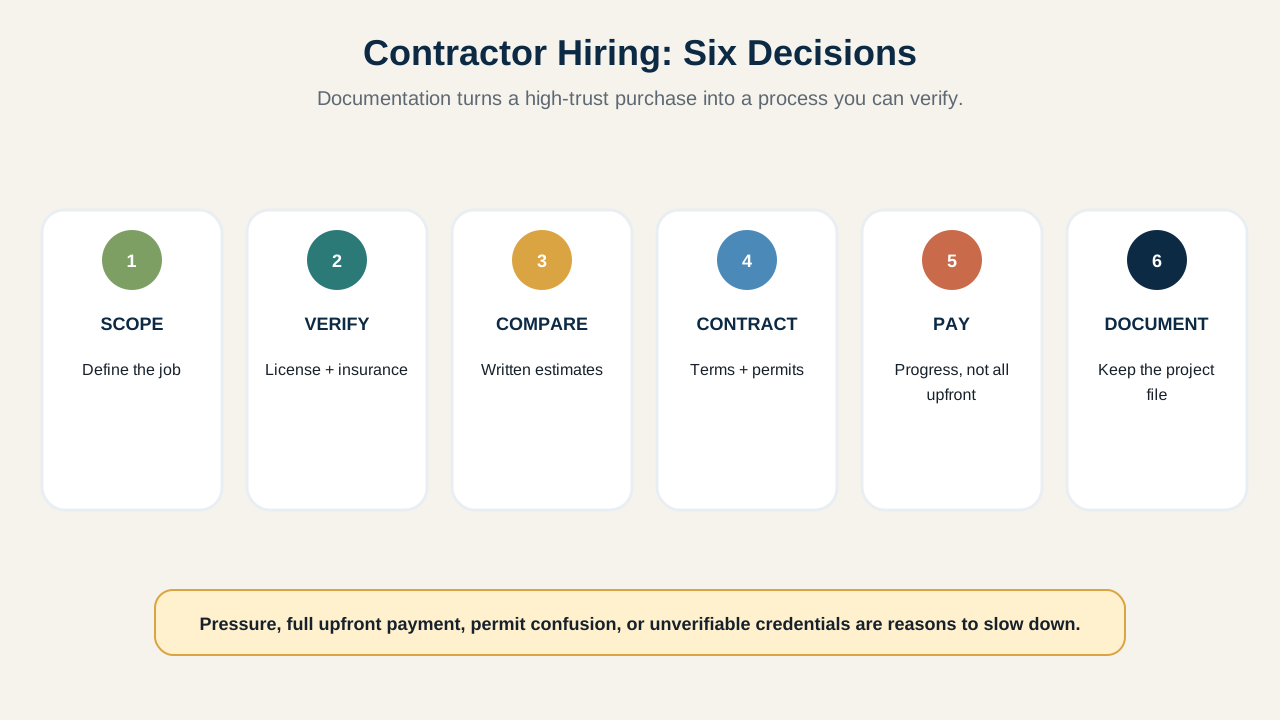
The contractor-selection process can be reduced to six steps:
Scope → Verify → Compare → Contract → Pay → Document
Define enough of the job to compare bids. Verify the business through the authority that actually regulates it. Compare the scope before comparing totals. Put the agreement in writing. Keep payment aligned with progress. Document the project from start to finish.
A contractor may still encounter surprises once work begins. The difference is that you’ll have a process for handling those surprises instead of relying on a handshake and memory: the same process our DIY or hire a professional guide walks through for deciding whether to call a contractor in the first place, part of a broader hire or DIY approach to home repairs.
Not every project on this list needs a contractor at all. Finding air leaks around windows and doors and testing your sump pump before heavy rain are both checks a homeowner can usually run first, and each explains where that particular job crosses into professional territory. Before any of them turns into a signed contract, it’s also worth checking whether your repair needs a permit: that answer can change the scope, the timeline, and who’s allowed to do the work. Before any of that, confirm the contractor is who they say they are. Verifying a contractor’s license and insurance before you hire walks through checking their license and insurance directly with the state or the insurer, not just taking their word for it.
Sources and further reading
We prioritize primary and authoritative sources. The sources below support the factual and technical guidance used in this article.
Practical Homeownership provides general educational guidance. Home conditions, local rules, manufacturer requirements, and the appropriate professional scope can vary.