DIY or Hire a Professional? How to Decide Before You Start a Home Repair

Decide DIY versus professional by weighing five questions: safe access, consequence of a mistake, component versus system complexity, permit or licensing requirements, and your ability to verify the repair, rather than comparing price alone.
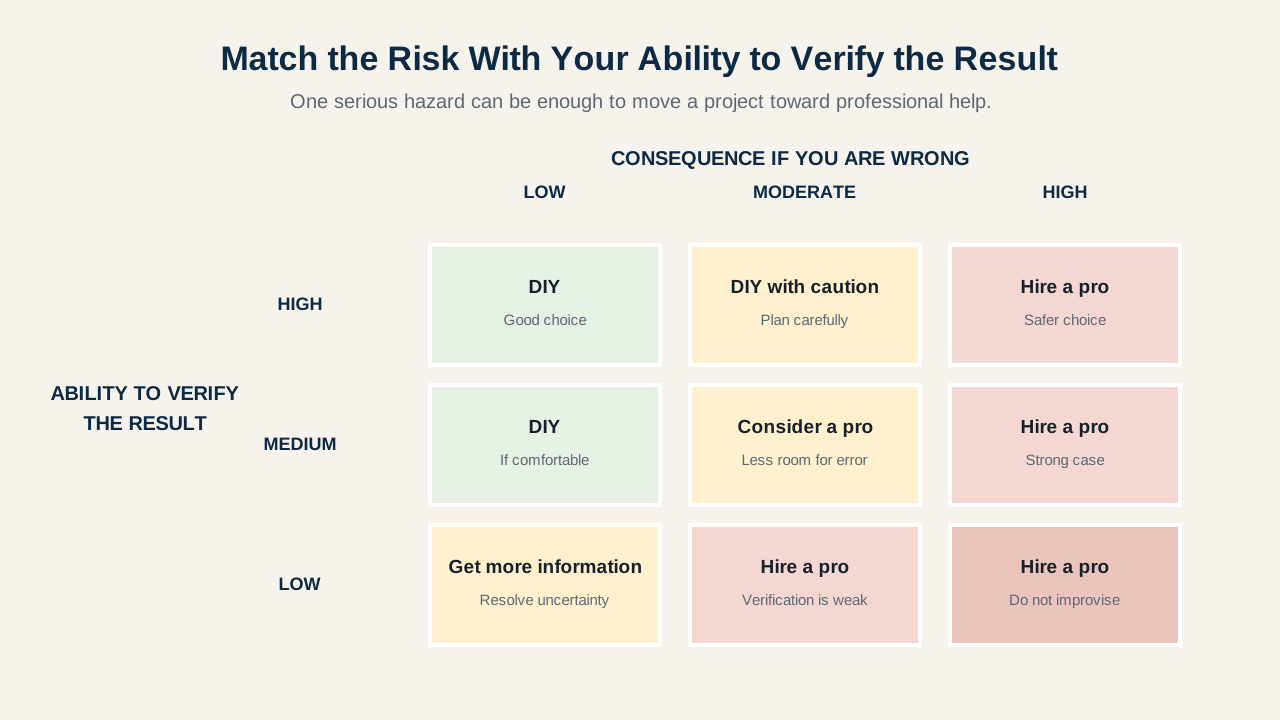
Owning a home means constantly deciding what to handle yourself and what to hand off to someone else.
Some jobs are easy calls. Replacing an HVAC filter or touching up paint does not usually demand the same judgment as opening a wall, working on a gas appliance, or climbing onto a steep roof.
The harder decisions fall in the middle.
You may know how to use the tools. A video may make the repair look straightforward. The parts may cost $40 while the contractor quote is $500. That can make DIY feel like the obvious choice.
But the price of the parts is not the only thing at stake.
Before starting a home repair, ask a better question:
What happens if I am wrong?
A good DIY decision is not just about whether you can complete the steps. It is about whether you can control the hazards, understand the system you are changing, recognize when the job has become more complicated than expected, and verify that the finished work is actually safe and correct.
This guide gives you a practical way to make that decision.
The short answer
A home repair is a better DIY candidate when the hazard is low, the work is visible and reversible, a mistake would cause limited damage, the rules are clear, and you can verify the result before putting the area back into service.
Hiring a qualified professional becomes the better choice when the work involves high-consequence hazards, hidden systems, structural changes, gas, significant electrical work, refrigerant, suspected asbestos, complex water damage, difficult roof access, or work that requires expertise, licensing, permits, or specialized testing you do not have.
The dividing line is not pride, tool ownership, or how easy the project looks online.
It is risk plus your ability to control and verify it.
Start With Five Questions
Before buying materials or taking anything apart, work through these five questions.
1. Can I make the job safely accessible?
Start with the environment, not the repair.
Can you reach the work without an unstable ladder, difficult roof access, standing water, exposed electrical hazards, confined spaces, or another condition that makes the setup itself dangerous?
A repair can be technically simple and still be a poor DIY project because of where it is located.
Cleaning something at ground level and cleaning the same thing from a steep second-story roof are not the same job.
OSHA’s construction data consistently identify falls as a leading cause of death in construction, particularly around roofs, ladders, and other elevated work. Those rules apply to workplaces, not ordinary homeowners doing their own repairs, but the hazard itself does not disappear when the worker is a homeowner.
If the access plan is the risky part, that alone may be enough reason to hire the job out.
2. What happens if the repair is wrong?
Think past the moment when the project looks finished.
If the caulk line is ugly, you can redo it.
If a plumbing connection hidden behind a wall leaks slowly for six months, the consequences are different.
If a repair affects combustion gases, electrical protection, structure, waterproofing, or a refrigerant system, the failure may not be obvious when you finish.
Ask:
- Could a mistake start a fire?
- Could it create a shock hazard?
- Could water damage spread before I notice it?
- Could the repair affect structural support?
- Could it expose people to gas, carbon monoxide, lead, asbestos, mold, sewage, or another hazardous material?
- Could the failure remain hidden?
The more serious the consequence and the harder the failure is to detect, the stronger the case for professional work.
A water-meter check for a hidden leak is a good example of catching that kind of hidden failure early, before it becomes a bigger repair. The same “catch it while it’s still observation” logic applies to a water heater: a visual water heater inspection can flag a leak, a corroded fitting, or a failing gasket while the fix is still simple, rather than after it has become a flooded utility closet.
3. Am I repairing a component or changing a system?
This distinction catches a lot of bad DIY decisions.
Replacing a removable HVAC filter is component-level maintenance.
Changing ductwork, opening a refrigerant circuit, altering electrical wiring, moving plumbing, modifying a load-bearing element, or changing part of a building envelope can affect a larger system.
System-level work creates more ways for one apparently small change to affect something you did not intend to change. It’s also why a single hot or cold room shouldn’t be treated as an isolated fix: figuring out why one room runs hotter or colder than the rest of the house usually means tracing airflow and return-path behavior through the whole system before deciding a register, a duct, or the equipment itself is actually at fault.
That does not automatically mean every system-related job requires a contractor. It means you should stop treating the task as an isolated repair.
The question becomes:
Do I understand the system well enough to predict what this change affects?
If the answer is no, getting professional help is not an admission that the repair is “too hard.” It is recognition that the consequences extend beyond the visible part in front of you.
4. Are permits, licensing, certification, or special rules involved?
Do not assume that owning the house means you can legally perform every type of work without approval.
Permit and licensing requirements vary by state and local jurisdiction. Model residential codes generally distinguish ordinary repairs from work that alters structural, electrical, gas, mechanical, or plumbing systems, but the rules that matter to your house are the rules adopted where you live.
Before significant work, check with your local building department.
Also watch for federal requirements that apply to particular hazards.
For example, EPA rules require Section 608 technician certification for work on stationary air-conditioning or refrigeration equipment that can violate the integrity of the refrigerant circuit. Adding or removing refrigerant, attaching gauges, and opening refrigerant lines are not ordinary homeowner maintenance.
Older homes create another layer. EPA warns that renovation in homes built before 1978 can disturb lead-based paint, and if your project is going to disturb painted surfaces in a home from that era, what to know about lead paint before you renovate explains how that federal rule applies differently depending on whether you’re the owner-occupant doing your own work, a landlord, or someone renovating for profit. The legal requirements differ depending on who is doing the work and why, but lead-safe practices matter even when a homeowner is doing work personally.
If you do not yet know what rules apply, that is a reason to investigate before starting, not after the wall is open.
5. Can I verify that the repair is correct?
This may be the most overlooked question.
Finishing the steps is not the same as proving the repair worked.
Some jobs give immediate feedback. A door closes correctly. A loose cabinet handle is secure. A small patch is flat and dry.
Other jobs require measurements, testing, inspection, pressure checks, electrical verification, combustion analysis, leak testing, or specialized knowledge before you can know the system is safe.
Ask yourself:
What is my acceptance test?
If the answer is only “it looks fine,” decide whether appearance is actually enough for that type of repair.
When you cannot independently verify a high-consequence result, professional work becomes much easier to justify. Radon mitigation is a good example of a job with a clear acceptance test: EPA guidance calls for testing your home for radon again after a mitigation system is installed, to confirm it actually worked.
A Quick DIY-or-Pro Decision Table
| What the job involves | Better DIY candidate | Stronger reason to hire |
|---|---|---|
| Consequence of a mistake | Cosmetic or easily reversible | Fire, shock, major water damage, structural failure, toxic exposure |
| Work location | Ground level, stable, easy access | Roof, tall ladder, difficult crawlspace, unsafe access |
| System complexity | Isolated visible component | Hidden or interconnected electrical, plumbing, HVAC, structural, gas, or envelope system |
| Ability to stop | Easy to pause and restore | Disassembly creates an urgent condition or leaves the home unsafe |
| Verification | Result can be checked directly | Specialized testing, inspection, or instruments needed |
| Rules | Ordinary maintenance with clear requirements | Permit, license, certification, inspection, or uncertain code requirements |
| Materials | Known ordinary materials | Suspected asbestos, lead-based paint, contaminated materials |
| Water or mold | Small, understood, clean-water issue | Hidden source, extensive damage, sewage/contaminated water, larger mold problem |
| Experience | You have successfully done comparable work | First attempt involves several unfamiliar systems at once |
This is not a legal classification table. It is a decision filter.
A job does not need to land in every right-hand column before you call a professional. One serious hazard can be enough.
Some Jobs Deserve an Immediate Pause
There are situations where the first step is not deciding which tutorial to watch. It is recognizing that the problem has crossed into a different risk category.
You smell or suspect leaking gas
Do not investigate a suspected gas leak by moving appliances, testing connections, or operating electrical switches.
CPSC guidance says that if you smell gas and suspect a leak, leave the house immediately. Do not turn lights or other electrical equipment on or off, and contact the gas supplier or emergency services from a safe location.
This is not a DIY diagnostic situation.
The job involves significant electrical work
Homeowners can safely observe many electrical warning signs without opening equipment or modifying wiring.
CPSC publishes homeowner electrical-safety checklists and recommends licensed electricians for electrical work in the home. Conditions such as unusually warm outlets or switches, exposed wiring, recurring breaker problems, or other indications of unsafe wiring deserve qualified evaluation.
The decision should become even more conservative around panels, service equipment, unknown circuits, wet electrical equipment, or any situation where you cannot confidently establish a safe de-energized condition. That same boundary is why installing a hardwired smoke or carbon monoxide alarm is electrical work for a qualified electrician, not a routine battery swap. The same boundary is what makes testing a GFCI outlet a monthly homeowner check rather than an invitation to open the receptacle or the panel yourself.
Knowing how to replace a part does not make electrical energy less hazardous.
The HVAC job opens the refrigerant circuit
There is a useful boundary between normal homeowner HVAC maintenance and refrigerant work.
Changing an accessible filter and keeping outdoor equipment clear are very different from connecting gauges, adding refrigerant, cutting refrigerant lines, or opening a pre-charged system.
EPA requires Section 608 technician certification for activities that can violate the integrity of the refrigerant circuit.
If the repair crosses that line, hand it to an appropriately certified technician.
You may disturb asbestos-containing material
You generally cannot identify asbestos simply by looking at a material.
EPA recommends that suspected material that is damaged or will be disturbed during renovation be sampled by a properly trained and accredited asbestos professional. EPA also advises homeowners not to saw, sand, scrape, or drill suspected asbestos-containing materials. That same caution applies to attic work: vermiculite insulation is a specific case where checking how much attic insulation you have means stopping and calling an accredited professional rather than measuring around the material yourself.
If an older floor tile, ceiling material, pipe insulation, siding, or another material raises an asbestos question, answer that question before demolition starts.
Do not create the exposure in the process of trying to identify it.
The project may disturb lead-based paint
Homes built before 1978 may contain lead-based paint.
Sanding, cutting, window replacement, demolition, and other renovation activities can create lead-contaminated dust. EPA recommends lead-safe certified contractors for renovation, repair, and painting work in pre-1978 homes, while also providing specific lead-safe practices for homeowners who choose to perform qualifying work in their own homes. Our guide on lead paint before you renovate walks through how that federal rule treats an owner-occupant differently from a landlord or a house flipper, which matters here because the DIY-versus-professional answer can change with who owns the project and why.
Do not treat an old painted surface exactly like a new one until you understand the lead risk and the rules that apply to your situation.
The mold or water problem is larger than the visible cleanup
EPA says that, in most cases, a homeowner can handle mold cleanup covering less than about 10 square feet, but the size of the visible patch is only one consideration.
A large amount of water damage, a larger mold area, hidden growth, or sewage or other contaminated water changes the decision.
The first job is still to understand and correct the moisture source.
If you are cleaning the surface without controlling the water problem, you are not really fixing the problem.
If you are not yet sure whether what you are looking at is condensation, a plumbing leak, or something else entirely, condensation or a possible leak walks through how to read the pattern before you decide how to respond. And if the source turns out to be plumbing rather than condensation, knowing where your main water shutoff valve is beforehand keeps a bad moment from getting worse while you sort out DIY versus professional repair.
The repair depends on roof access or serious fall exposure
The repair itself may be simple. The access may not be.
A homeowner who is comfortable changing a vent cap at ground level should not automatically treat the same task on a steep or high roof as equivalent.
Height, pitch, surface condition, weather, ladder setup, edge exposure, and the need to carry tools all change the risk.
If the work cannot be reached and performed with a setup you can control, hire it out.
What Usually Makes a Good DIY Project?
Good DIY projects tend to share a few characteristics.
They are low consequence, visible, reversible, and easy to verify.
Examples may include:
- replacing accessible HVAC filters;
- cleaning accessible dryer-lint areas according to manufacturer guidance;
- weatherstripping or simple caulking where the source and purpose are understood;
- painting or touch-up work when hazardous old coatings are not an issue;
- replacing simple non-powered hardware;
- tightening accessible cabinet or furniture hardware;
- basic cleaning and maintenance tasks;
- monitoring a stain, moisture pattern, or other condition before deciding on a repair.
Even simple projects still depend on the actual conditions in your home.
A straightforward task can stop being straightforward when you discover water damage, unusual wiring, deteriorated materials, suspect old coatings, structural movement, or another unexpected condition.
That leads to one of the most important DIY skills:
Knowing when the job has changed.
Starting DIY Does Not Mean You Have to Finish DIY
Home repairs often reveal information you could not see beforehand.
You remove a trim piece and find rot.
You expect one plumbing connection and find several previous repairs.
You begin preparing an older painted surface and realize you do not know whether lead is present.
You inspect condensation and discover that the moisture source may be inside a wall.
The original decision was based on the information you had before opening the project.
New information should trigger a new decision.
Do not let the time or money already invested force you to continue.
Stopping at a safe point and calling a professional can be the most successful outcome of a DIY attempt.
Use the Cost of Being Wrong, Not Just the Contractor Quote
Contractor prices are easy to see.
The cost of failure is harder to see.
Suppose a professional quote feels expensive compared with the materials needed for DIY.
Before comparing those two numbers, consider what belongs on the DIY side:
- tools you need but do not own;
- protective equipment;
- disposal;
- permits or inspection fees where applicable;
- your time;
- materials lost to mistakes;
- the cost of reopening finished work;
- possible damage if the repair fails;
- professional correction if the first attempt does not work.
This does not mean DIY is financially irrational.
Many low-risk projects are excellent ways to save money and build useful homeowner skills.
It means the comparison should be:
total DIY exposure versus total professional cost, not simply parts versus labor.
A $50 repair with a $50 downside is a different decision from a $50 repair that can create thousands of dollars in hidden damage.
Skill Matters, but So Does Specific Experience
“I am handy” is not a complete risk assessment.
Home repair skills transfer, but not perfectly.
Someone experienced with finish carpentry may be excellent at measurement, tools, and problem solving while still having no reason to open an electrical panel.
Someone comfortable replacing plumbing fixtures may not understand structural framing.
Someone who can perform routine HVAC maintenance may still need an EPA-certified technician once the refrigerant circuit is involved.
Ask a narrower question:
Have I successfully done this type of work, on this type of system, with comparable consequences if something goes wrong?
That is much more useful than asking whether you are generally good at DIY.
The Permit Question Comes Before the Project
Do not use a permit as a post-project paperwork problem.
Check first.
The International Code Council advises homeowners to contact their local building-safety department before starting improvement work because local requirements vary. Electrical, mechanical, structural, plumbing, reroofing, equipment replacement, and many remodeling projects commonly trigger permitting or inspection requirements.
Your jurisdiction may allow homeowners to perform certain permitted work themselves. It may restrict other work to licensed trades. Requirements can also change with project scope.
That is why this guide does not label specific jobs as universally “legal DIY” or “contractor only.”
The correct answer depends on where the house is and exactly what you are changing.
If You Hire a Professional, Hiring Is Part of the Repair
Deciding not to DIY does not mean your judgment is finished.
You still need to choose the person or company doing the work.
The Federal Trade Commission recommends checking contractor licensing and insurance with the appropriate state or county authority, getting multiple written estimates, and reviewing a written contract rather than automatically accepting the lowest bid. Once those estimates are in hand, comparing contractor estimates side by side (scope, materials, exclusions, and payment terms, not just the total) is what actually makes the bids comparable.
For higher-risk or regulated work, verify the credential that actually matters to the job.
That may include:
- contractor licensing required by your jurisdiction;
- EPA lead-safe certification for covered renovation work;
- Section 608 certification for refrigerant service;
- asbestos accreditation where applicable;
- another state or local trade credential.
Do not accept “licensed and insured” as a magic phrase without checking what the license actually covers.
And be cautious when someone pressures you for an immediate decision, demands full payment up front, or wants you to pull permits that the contractor should be handling. Those are among the warning signs highlighted by the FTC.
A Simple Three-Level Decision
When you finish evaluating the job, place it in one of three buckets.
Level 1: Reasonable DIY
The job is low hazard, visible, reversible, easy to stop, and easy to verify.
You understand the task and the surrounding system.
A mistake would be inconvenient rather than dangerous or destructive.
Proceed deliberately.
Level 2: DIY Only After More Information
You may be capable of doing the work, but one question remains unresolved.
Maybe you need to:
- confirm whether a permit is required;
- identify the material;
- understand the source of moisture;
- verify that lead or asbestos is not an issue;
- read the manufacturer’s procedure;
- understand how another system is affected;
- determine how the finished repair will be tested.
Do not use uncertainty as permission to improvise.
Resolve the question first.
Level 3: Hire a Qualified Professional
The project involves a high-consequence hazard, unsafe access, regulated work, specialized testing, a hidden or interconnected system, or a failure you cannot confidently detect.
Or you simply do not have the experience to control the job safely.
That is enough.
You do not need to prove that the project is impossible before hiring someone.
The Best DIY Decision Is Sometimes Not Doing the Repair Yourself
Homeownership rewards learning.
The more you understand your house, the better you become at noticing problems early, explaining symptoms, maintaining equipment, evaluating contractor recommendations, and knowing when something does not look right.
But becoming a capable homeowner does not mean becoming every trade.
A useful homeowner skill set includes both sides of the line:
what you can safely handle and what you should recognize early enough to hand off.
So before the next repair, do not start with:
“Can I find a video showing me how to do this?”
Start with:
- Can I make the job safe?
- What happens if I am wrong?
- Am I changing one component or a larger system?
- What rules apply?
- How will I prove the repair is correct?
If those answers are clear and the consequences are limited, DIY may be a good choice.
If they are not, the project has already given you useful information.
It is telling you to stop before the cost of being wrong gets serious.
This decision framework is part of a broader hire or DIY approach to home repairs, and it pairs naturally with routine upkeep: the first-time homeowner maintenance checklist covers the baseline habits that help you notice a problem early enough to still have this decision in front of you, instead of an emergency behind you.
Once you’ve decided a job belongs to a professional, the next decision is picking the right one. Our guide on hiring a home improvement contractor without guessing walks through verifying, comparing, and paying a contractor with documentation instead of guesswork. The same safety-first logic applies to smaller checks too: finding air leaks around windows and doors, testing your sump pump before heavy rain, checking your home’s water pressure, checking drainage around your foundation, checking how much attic insulation you have, testing a GFCI outlet, and testing your garage door’s auto-reverse safety feature all include their own DIY-versus-professional lines.
That same judgment call comes up before any project starts: when to get a home energy audit, finding your sewer cleanout, and checking whether your repair needs a permit are all decisions worth making before you pick up a tool or call a contractor. The same before-you-start habit applies to three more decisions we cover in detail: responding to a minor indoor water leak in the first 24-48 hours, reading your electric meter to track home energy use, and verifying a contractor’s license and insurance before you hire.
Sources and further reading
We prioritize primary and authoritative sources. The sources below support the factual and technical guidance used in this article.
- Occupational Safety and Health Administration: OSHA's Fall Prevention Campaign
- U.S. Consumer Product Safety Commission: CPSC Issues Winter Weather Safety Tips to Prevent Fires and Carbon Monoxide Poisoning
- U.S. Consumer Product Safety Commission: Home Electrical Safety Checklist
- U.S. Environmental Protection Agency: Section 608 Technician Certification Requirements
- U.S. Environmental Protection Agency: Lead-Safe Renovations for DIYers
- U.S. Environmental Protection Agency: Protect Your Family from Exposures to Asbestos
- U.S. Environmental Protection Agency: A Brief Guide to Mold, Moisture and Your Home
- International Code Council: Consumer Safety
- Federal Trade Commission: How To Avoid a Home Improvement Scam
Practical Homeownership provides general educational guidance. Home conditions, local rules, manufacturer requirements, and the appropriate professional scope can vary.