Where Is My Main Water Shutoff Valve? How to Find It Before a Leak

Find your homeowner-controlled main water shutoff valve before an emergency, verify it works with a simple faucet test, label it, and learn your local utility's rules for the separate meter-side valve.
There’s a bad time to learn where your main water shutoff valve is: when water is already spreading across the floor. A new homeowner can prevent that problem with a simple task: find the homeowner-controlled main shutoff before an emergency, make sure you understand what it controls, and document where it is.
The challenge is that there’s no universal location. The valve may be in a basement, crawlspace, garage, utility area, on an exterior wall, or near the point where the water service enters the house, and homes supplied by wells have different arrangements from homes on municipal water. There may also be another valve near the water meter that belongs to or is controlled by the water utility, and those valves aren’t automatically interchangeable.
The short answer
Start by following the main water service line to the point where it enters your home. Municipal utilities commonly tell homeowners to look in a basement or crawlspace, a garage, a utility or mechanical area, near the water heater, on an exterior wall, or near the water meter or the line that runs from it toward the house.
Your goal is to identify the homeowner-operated main shutoff, not automatically the utility’s meter or curb valve. Once you find it, record the location, identify the valve type, and confirm how your local utility expects homeowners to handle meter-side shutoffs. If the valve is corroded, damaged, leaking, or difficult to operate, do not force it. Have it evaluated before an emergency makes the problem urgent.
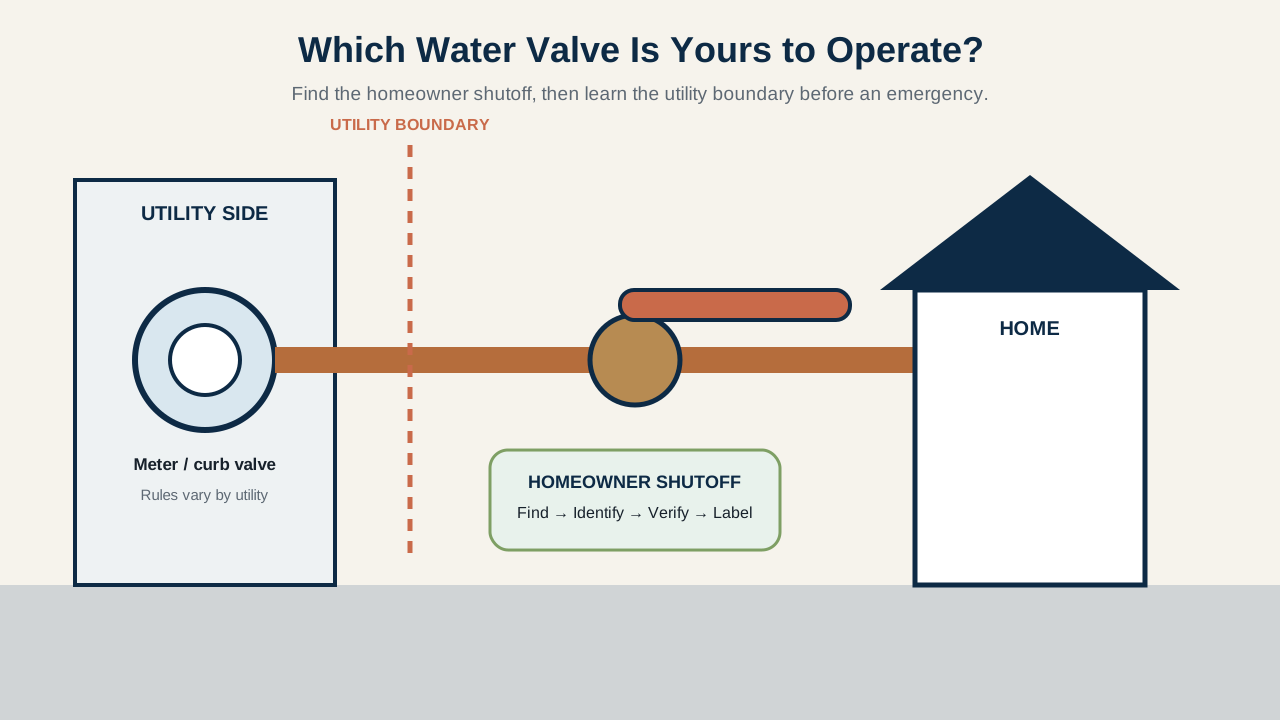
Your Home May Have More Than One “Main” Valve
The phrase “main shutoff” gets used loosely. In a municipal-water home, you may encounter both a homeowner-controlled shutoff on the service line to the house, and a utility-controlled valve at or near the meter or curb. Depending on the city, the utility-side valve may be accessible to homeowners, restricted to utility personnel, or governed by specific emergency procedures, and that local difference matters.
San Francisco Public Utilities Commission tells customers that meter equipment should be accessed by its field staff. Austin Water, by contrast, gives customers emergency instructions that can include a city shutoff valve if the property-owner valve can’t be used. There’s no responsible national article that should tell every U.S. homeowner to open the meter box and turn that valve. Instead, identify the valve intended for you to operate, and learn your utility’s rules before the emergency.
Where to Look Inside the House
A common pattern is that the homeowner shutoff is installed close to where the water service line enters the structure. Official utility guidance shows several recurring locations: basement, crawlspace, garage, utility room, near the water heater, an exterior-facing wall, or immediately inside the home from the water meter or service line.
The most reliable clue is the pipe itself. Find where the main water supply enters the building, trace the accessible piping, and look for a valve capable of isolating water going to the rest of the house.
Your Home Inspection Report May Already Tell You
Before crawling around the house, check the documents you received when you bought it. Some home-inspection standards require the inspector to report the location of the homeowner’s main water supply shutoff valve. Texas inspection standards, for example, specifically require inspectors to report both the water meter location and the homeowner’s main water supply shutoff. Your state may use different standards, but the inspection report is still one of the first places worth checking.
Other useful places include builder documents, plumbing diagrams if you have them, previous-owner notes, utility information, and labels already attached near mechanical equipment. Don’t assume an unlabeled valve is the main simply because it’s large. Confirm what it controls.
What Does the Main Shutoff Look Like?
Two common residential valve styles are ball valves and gate valves.
A ball valve usually has a lever handle. In a typical installation, the handle parallel with the pipe means open, and perpendicular to the pipe means closed; the lever generally moves about one quarter turn.
A gate valve usually has a round wheel handle, and it normally closes by turning clockwise through multiple rotations.
Official municipal guidance shows both styles in residential use, but valve designs vary. Use the actual valve, labels, plumbing arrangement, and local guidance rather than relying only on a diagram from the internet. If you can’t confidently identify the valve, ask a plumber or your water utility. That’s much better than testing random plumbing controls.
Don’t Confuse a Fixture Shutoff With the Whole-House Shutoff
Sinks, toilets, washing machines, ice makers, and other fixtures may have their own local shutoff valves. Those are useful because a problem isolated to one fixture may be controlled without shutting water off to the entire house. But a fixture shutoff doesn’t necessarily protect you when you don’t know where the leak originates, a pipe has failed upstream of the fixture, multiple areas are affected, or the local valve doesn’t stop the flow.
Your home baseline should include both where the whole-house shutoff is, and which important fixtures have their own accessible shutoffs. You don’t need to memorize every valve on day one. You do need to know the main.
How to Verify You Found the Right Valve
Finding a valve isn’t the same as proving it controls the house. Official water-utility leak guidance commonly uses a simple verification method: close the homeowner’s main shutoff, then open a faucet and confirm that the water flow stops after pressure in the line dissipates. Portland Water Bureau specifically describes this method when helping customers isolate leaks.
That doesn’t mean every homeowner should force an old valve through a test. Before operating it, look at the condition, and stop and get help if the valve is heavily corroded, visibly damaged, already leaking, has a broken handle, won’t move with normal hand operation, or is located somewhere unsafe to access. Henrico County homeowner guidance specifically cautions against using tools to force a difficult water valve, because the valve can be damaged.
If the valve is old and questionable, the valuable result of your inspection may simply be that you found it but it needs professional attention before you can rely on it, and that’s much better information to discover on a dry afternoon than during a burst pipe.
A Safe Verification Routine
If the valve is clearly the homeowner-controlled main, appears to be in serviceable condition, and your local guidance doesn’t prohibit operation, use a conservative check:
- Make sure no dishwasher, washing machine, ice maker, irrigation cycle, or other water-using equipment is actively running.
- Tell other people in the house that you’re briefly shutting off the water.
- Operate the valve normally according to its design, without forcing it.
- Open a faucet and see whether the flow stops after the remaining pressure is released.
- Restore the valve to its normal open position.
- Confirm normal water service returns.
- Look around the valve and nearby connections for any new dripping.
If anything feels wrong, stop. Don’t make valve repair part of the same experiment. A main shutoff is most valuable when it can be operated predictably.
Label It After You Verify It
Once you’re confident you’ve identified the homeowner main shutoff, make the next emergency easier. Household emergency-preparedness guidance, including from the City of Long Beach, recommends that everyone in the household know how and when to shut off water at the main switches, and a simple tag reading “MAIN WATER SHUTOFF” puts that knowledge within reach of anyone in the house, not just the person who found the valve, saving someone from tracing pipes under pressure during an emergency.
Also take a clear photo, record the room or location, note any access instructions, make sure stored boxes or furniture don’t block it, and tell other responsible household members where it is. If you use a digital home-maintenance record, store the photo there. The goal isn’t merely that you can find the valve. It’s that the household can find it when the person who mapped it isn’t home.
The Meter Valve May Not Be Yours to Operate
This deserves its own rule, because internet advice is inconsistent. Some water utilities allow or instruct homeowners to operate a meter-side or city shutoff under certain conditions; others specifically prohibit customer access or reserve the valve for utility staff. So before buying a “meter key” because a video told you to, check your water provider’s rules.
Ask which valve is the customer-owned shutoff, whether the meter box is customer-accessible, who’s allowed to operate the curb or utility valve, and whether there’s an emergency number if the house valve fails. Record the answer with the shutoff location. That small piece of local knowledge is far more useful than a generic national instruction.
What If You Cannot Find the Valve?
Don’t wait for a leak to solve the mystery. Work through the problem while the system is normal.
Check the home inspection report first. The location may already be documented. Trace the service entry by looking for where the main water line enters the house. Look near the meter path, since the house valve is often located along the service line between the meter and the interior distribution system. Check likely utility spaces: basement, crawlspace, garage, mechanical room, near the water heater, or an exterior service area. Ask the water utility, since they can often clarify where their responsibility ends and what customer shutoff arrangements are common locally. And if the valve is hidden, inaccessible, missing, or unclear, ask a licensed plumber, who can identify the system and tell you what needs to change.
A house with no usable homeowner shutoff isn’t a problem to postpone indefinitely.
What If the Valve Will Not Close?
Don’t turn this into a strength contest. A main valve that’s stuck, badly corroded, leaking, or incapable of fully stopping water needs attention, and forcing an old valve can damage the handle, stem, valve body, or connected piping.
If normal operation doesn’t work: stop, keep the area accessible, document the problem, contact a plumber, and learn the utility’s emergency shutoff procedure in case water needs to be stopped before the house valve is repaired. At that point the project has moved from “locate and document” into plumbing repair: a different DIY decision.
When Should You Use the Main Shutoff?
The main valve becomes useful when the water supply to the house needs to be stopped and a smaller local shutoff isn’t sufficient or practical. Examples include a burst or broken supply pipe, a major uncontrolled plumbing leak, a failed fixture or appliance connection that can’t be isolated locally, or plumbing work that requires the house supply to be off.
If a leak is clearly limited to one fixture and a reliable fixture shutoff is accessible, isolating only that fixture may be enough. But during a rapidly developing leak, the priority is controlling the water source safely, and if you can’t identify the source quickly, the whole-house shutoff may be the simplest control you already know. A verified main shutoff is also what makes it possible to safely isolate the house while you check for a hidden leak that the water meter has flagged but that you haven’t located yet, or while you’re addressing a leak found during a visual water heater inspection.
Water and Electricity Change the Decision
A leaking pipe can create hazards beyond plumbing. Do not enter standing water or reach for a valve if doing so would expose you to electrical equipment, damaged wiring, or another immediate hazard. The rule is simple: stopping property damage is not more important than avoiding an electrical injury. If the route to the shutoff is unsafe, move away from the hazard and get emergency or professional help.
This is another reason to choose an accessible homeowner shutoff location when a plumbing system is being upgraded. Emergency controls are only useful if they can be reached safely.
Build a Home Shutoff Map
The main water valve should be one item in a larger first-time-homeowner control map. Record the main homeowner water shutoff, important fixture shutoffs, the water meter location, the utility emergency contact, the gas emergency procedure, the electrical service location (without turning the exercise into panel work), and the HVAC filter location.
You’re not trying to become a technician. You’re creating an emergency map of the house. This connects directly to the first-time homeowner maintenance baseline: the first month is the best time to learn where the controls are, because nothing is actively going wrong.
A Quick Main-Shutoff Checklist
| Question | Good state | Needs attention |
|---|---|---|
| Can you find the homeowner-controlled main quickly? | Location documented and accessible | Location unknown |
| Do you know what valve you are looking at? | Main verified | Valve purpose uncertain |
| Is access clear? | Reachable without moving heavy storage | Blocked or unsafe |
| Does the valve appear serviceable? | No obvious damage or leaking | Corroded, damaged, leaking |
| Can it be operated normally? | Moves as designed without force | Stuck or requires excessive force |
| Does water stop when verified? | Faucet flow stops after pressure dissipates | Flow continues |
| Is it labeled? | Clear tag/photo/documentation | Only one person knows |
| Do you know the utility-side rules? | Customer vs. utility responsibilities documented | Meter/curb procedure unknown |
You don’t need an emergency to complete any of those checks. That’s the point.
Find It Before You Need It
The main water shutoff isn’t complicated because of what it does. It’s complicated because homeowners often wait until the worst possible moment to learn where it is. Do the work in the opposite order: find the likely shutoff, identify what it controls, verify it conservatively when safe, label and document it, and know what to do if the homeowner valve fails and the utility valve is needed. Then leave it alone until maintenance or an emergency requires it.
A short search today is valuable because it removes one major unknown from a future water problem, and the best emergency control in the house is the one you already know how to reach.
This shutoff routine is one part of a larger homeowner tools approach to home maintenance: find the controls before you need them, verify they work, and know the line between homeowner maintenance and a professional’s job. Once you know where the shutoff is, checking your home’s water pressure is a natural next baseline to establish while the system is working normally, and finding your sewer cleanout is the other access point worth locating on the same walkthrough, right alongside a visual water heater inspection, since knowing the shutoff is what makes that inspection actually useful if it turns up a leak.
Sources and further reading
We prioritize primary and authoritative sources. The sources below support the factual and technical guidance used in this article.
- San Francisco Public Utilities Commission: Home Water Shutoff Valve
- Austin Water, City of Austin: Water Leaks
- Portland Water Bureau, City of Portland: How to check for leaks
- County of Henrico, Virginia: What to do if you have a high water bill?
- City of Long Beach Department of Disaster Preparedness and Emergency Communications: Emergency Planning Guide - Get Prepared Now!
- Texas Real Estate Commission: 22 Tex. Admin. Code Section 535.231 - Standards of Practice - Minimum Inspection Requirements for Plumbing Systems
Practical Homeownership provides general educational guidance. Home conditions, local rules, manufacturer requirements, and the appropriate professional scope can vary.