Condensation or Leak? How to Tell Where the Moisture in Your Home Is Coming From

Found unexplained moisture? Learn how timing, location, weather, humidity, and recurrence can help you tell condensation from a possible leak.
Finding water where it shouldn’t be can make a homeowner jump straight to the worst conclusion.
A wet windowsill becomes a leaking window. A ceiling stain becomes a roof leak. Water on a pipe becomes failed plumbing.
Sometimes that’s exactly what’s happening.
Sometimes it isn’t.
Condensation, plumbing leaks, exterior water intrusion, appliance problems, and groundwater can leave surprisingly similar clues. The real question isn’t just “Is this condensation or a leak?”
It’s:
What pattern is the moisture following?
That pattern can often tell you what to investigate next without taking walls apart, climbing onto the roof, or guessing at repairs you don’t yet understand.
The short answer
Condensation forms when moisture in the air collects on a surface cold enough for water vapor to turn into liquid water. A leak involves liquid water escaping from plumbing, equipment, or somewhere outside the building envelope.
The location of the water matters, but so do timing, weather, temperature, recurrence, and what else is happening nearby.
Water that repeatedly appears on a cold surface during humid conditions may point toward condensation. Moisture that appears beneath plumbing regardless of weather may make a plumbing source more likely. A stain that worsens after rain may suggest exterior water intrusion.
Those are clues, not proof.
The safest approach is to observe the pattern, narrow the likely source, correct simple moisture conditions when appropriate, and escalate when the source is hidden, persistent, or potentially hazardous.
First, Don’t Ask “Condensation or Leak?” Yet
A single wet spot usually doesn’t tell you enough.
Imagine finding water on the outside of a cold-water pipe.
One explanation is obvious: the pipe itself could be leaking.
But cold plumbing can also collect condensation when humid air reaches the cold pipe surface. EPA moisture guidance specifically recognizes both plumbing leaks and condensation on cold-water lines as potential moisture problems.
Same pipe. Similar visible water. Different causes.
So before deciding what the problem is, collect a little context.
Ask:
- When did the moisture appear?
- Does weather affect it?
- Is the surface itself wet, or does water seem to be coming from somewhere else?
- Does it happen under the same conditions every time?
- Is there plumbing, HVAC equipment, a bathroom, a roof, or an exterior wall nearby?
- Is the surrounding material becoming stained, swollen, soft, or damaged?
- Does the area smell persistently musty?
You’re not trying to become a building diagnostician.
You’re trying to avoid making a bad assumption too early.
What Condensation Actually Is
Condensation forms when humid air is cooled to its dew point at a surface. As air cools, it reaches saturation with less water vapor; once the air next to a cold surface reaches the dew point, some of that vapor condenses into liquid water.
That’s why condensation often appears on things like:
- cold windows;
- cold-water pipes;
- metal surfaces;
- exterior walls with cold spots;
- some ducts or other cooled surfaces.
ENERGY STAR describes the same process at windows: interior condensation can form when the window surface falls below the dew point of the indoor air.
One clue worth watching for is distribution.
Condensation often forms across an exposed cold surface rather than emerging from one obvious joint, crack, or penetration.
But even that isn’t enough to prove the diagnosis.
A wet window can have a condensation problem, a water-intrusion problem, or sometimes both.
Clue 1: When Does the Moisture Appear?
Timing is one of the most telling clues you have.
It shows up after rain
If a stain appears or becomes noticeably worse during or after rainfall, exterior water intrusion deserves attention.
Possible sources can involve the roof, windows, exterior walls, flashing, drainage, foundation, or other parts of the building envelope.
That does not mean the visible stain identifies the exact point where water entered.
It means weather is part of the pattern.
Instead of repainting the stain, record when it becomes wet and what the weather was doing.
It appears during cold weather
Moisture that develops on windows, pipes, exterior-wall surfaces, or other cold materials during cold conditions can be consistent with condensation.
Cold weather can make indoor surfaces colder. When humid indoor air meets a surface at or below its dew point, condensation can form.
Again, don’t stop at “it’s condensation.”
The next question is why that surface is staying wet often enough to become a problem.
It appears after showers or cooking
Showers, cooking, dishwashing, drying clothes indoors, and other ordinary activities add moisture to indoor air.
If moisture repeatedly appears around cold surfaces after these activities and then declines as the room dries, indoor humidity and ventilation become more plausible contributors.
That’s especially telling if the pattern repeats under similar conditions.
It appears regardless of weather or indoor humidity
Water beneath a sink, toilet, appliance, supply line, drain, or other plumbing location that appears independently of weather may make a direct plumbing or equipment source more likely.
The closer the timing is to use of that fixture or appliance, the more useful the clue becomes.
Still, observation comes before disassembly.
Clue 2: Where Is the Water?
Location doesn’t give you a diagnosis, but it narrows the field.
On the inside surface of a window
Water spread across the interior glass during cold weather is commonly associated with condensation.
ENERGY STAR makes the same point specifically about windows: even a well-performing window can fog up on the inside when its surface temperature drops below the dew point of the humid air in the room.
If this happens regularly, indoor humidity is worth checking.
But water concentrated around a frame, trim, wall, or a specific point after rain deserves a different level of suspicion.
The pattern matters more than the fact that “the window is wet.”
On a cold-water pipe
Look at the pipe before touching or modifying anything.
If small droplets form broadly along the cold surface, particularly during humid conditions, condensation becomes plausible.
If water seems concentrated at a fitting, joint, valve, or one specific location, a leak becomes more plausible.
A cold pipe can also have both problems, so persistent moisture still deserves attention.
Under a sink
The first question is whether the moisture appears when the faucet or drain is being used.
Without taking the plumbing apart, you may be able to observe accessible connections and determine whether water appears during use.
If the source isn’t visible or the repair is beyond simple homeowner maintenance, call a plumber rather than turning a small leak into a larger one.
On a ceiling
A ceiling stain deserves investigation, but “ceiling stain equals roof leak” is too simple.
Nearby plumbing, bathrooms, HVAC components, condensation in an attic or roof assembly, and exterior water intrusion can all be relevant depending on the house.
Weather and timing become especially valuable here. Does it get worse after rain, after someone showers upstairs, or only during a particular heating or cooling season? Or does the ceiling stay wet no matter what?
Do not open the ceiling simply to find out.
Persistent or expanding ceiling moisture is a good reason for professional diagnosis.
In a basement or crawlspace
Moisture below grade can have several sources.
The EPA notes that water can seep through basement floors, while drainage toward the house and inadequate exterior water management can contribute to basement moisture.
Plumbing leaks, condensation, and groundwater can also occur in the same area.
Ask whether the condition changes after rainfall, seasonal groundwater changes, plumbing use, or changes in indoor humidity.
A damp basement is a condition to understand, not a diagnosis by itself.
Clue 3: Is the Water Sitting on the Surface or Coming Through the Material?
This distinction can be useful.
Condensation often begins on the surface because that surface is cold enough for water vapor to condense there.
Water intrusion or plumbing leaks can wet materials from another location.
For example:
- droplets visible across a cold pipe can be consistent with condensation;
- drywall becoming progressively stained or soft suggests the material itself is being wetted;
- moisture appearing beneath a plumbing connection may point toward liquid water escaping from the system;
- a broad film of moisture on cold glass may reflect indoor humidity.
But don’t turn this into another absolute rule.
Condensation can also occur in hidden cavities, and leaks can run along materials before becoming visible.
Observation narrows possibilities. It doesn’t replace diagnosis when the source is concealed.
Clue 4: Does It Happen Under the Same Conditions Every Time?
Recurring patterns can be especially useful evidence.
If a window becomes wet every cold morning but dries as temperatures rise, that’s a very different pattern from a window frame that becomes wet every time it rains.
If a cold pipe sweats only during humid summer weather, that points in a different direction from a fitting that drips throughout the year.
If bathroom moisture appears after long showers but improves when the exhaust fan is used, humidity and ventilation are giving you useful information.
Keep a simple record if the source isn’t obvious:
- Date.
- Weather.
- Outdoor temperature if relevant.
- Indoor humidity.
- What fixtures or appliances were running.
- Where the moisture appeared.
- Whether it dried.
- Whether the stain changed.
A few observations can be much more useful than immediately applying caulk or paint.
Clue 5: What Is the Moisture Doing to the House?
Water that repeatedly returns deserves more attention than a one-time droplet that has an obvious explanation.
Look for changes such as:
- staining;
- peeling or bubbling paint;
- swollen finishes;
- soft or deteriorating material;
- corrosion or rust;
- persistent musty odor;
- visible mold;
- recurring dampness.
The EPA specifically warns against simply painting or sealing over wet material or visible biological growth.
If the material keeps getting wet, a moisture source or moisture-producing condition is still active.
Cosmetic repair comes after moisture control, not before it.
A Quick Comparison: Condensation or Leak?
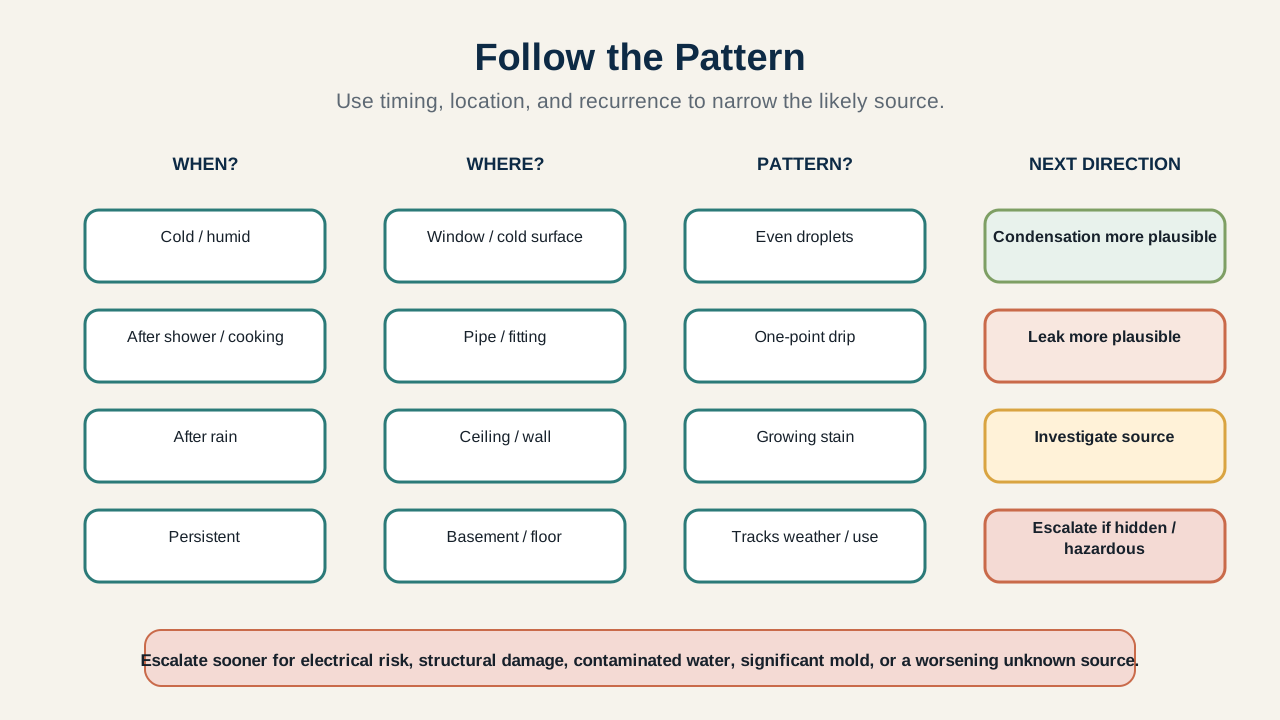
| What you observe | More consistent with | But also consider |
|---|---|---|
| Water spread across the inside of a cold window | Condensation | Window/exterior water intrusion if moisture follows rain or concentrates around the frame |
| Water appears mainly after rain | Exterior water intrusion | Condensation in a roof or attic assembly can sometimes create confusing symptoms |
| Small droplets along a cold-water pipe | Condensation | Actual plumbing leak, especially if water concentrates at a joint or fitting |
| Water directly beneath a sink connection | Plumbing source | Condensation on nearby cold piping |
| Ceiling stain below a bathroom | Plumbing or fixture source | Exterior/roof intrusion depending on location and timing |
| Ceiling stain worsens after storms | Exterior water intrusion | Other moisture sources still need to be ruled out |
| Window moisture after showers or cooking | Condensation/high indoor humidity | Window leakage if the pattern also follows weather |
| Basement dampness after heavy rain | Groundwater/exterior moisture | Plumbing leak or condensation |
| Persistent moisture near HVAC equipment | Condensate/drainage or equipment issue | Nearby plumbing or other moisture source |
| Musty odor with no visible water | Hidden moisture is possible | Source requires investigation rather than guessing |
The third column is the one that matters most.
Homes don’t always give you one clean symptom with one clean explanation.
Use Humidity as Context, Not as Proof
A small hygrometer can help you understand what the indoor air is doing.
EPA guidance recommends keeping indoor relative humidity below 60 percent when possible and says a range around 30 to 50 percent is generally preferable.
But humidity is not a leak detector.
A room reading of 65 percent does not prove that a wet ceiling is condensation.
A reading of 40 percent does not prove the house has no hidden moisture problem.
Use humidity as another piece of evidence.
If moisture appears repeatedly on cold surfaces while indoor humidity is elevated, that’s useful context.
Also remember that an appropriate indoor humidity level can vary with outdoor temperature and climate. In very cold conditions, even humidity that feels comfortable indoors can still lead to condensation on sufficiently cold building surfaces.
So don’t chase one number blindly.
Watch what the house is telling you.
What You Can Safely Check Yourself
You can learn quite a bit without dismantling anything.
Observe the timing
Record whether moisture correlates with:
- rainfall;
- showering;
- cooking;
- appliance use;
- HVAC operation;
- cold weather;
- humid weather.
Look from a safe location
Check visible, accessible areas around:
- sinks;
- toilets;
- appliances;
- windows;
- exposed plumbing;
- HVAC equipment;
- ceilings and walls;
- basement or crawlspace areas that are safe to enter.
Check indoor humidity
A basic hygrometer can provide useful context for recurring condensation.
Photograph changes
A photo today compared with one taken next week can tell you whether a stain is expanding or a material is deteriorating.
Look at your water use
If you suspect a plumbing leak but can’t see the source, abnormal water use can provide another clue.
Your goal is evidence, not invasive diagnosis.
What Not to Do Just to Find the Source
Don’t turn a moisture investigation into unnecessary demolition.
A homeowner trying to distinguish condensation from a leak generally should not start by:
- cutting holes in drywall;
- removing ceilings;
- opening electrical equipment;
- dismantling plumbing systems;
- removing roofing;
- climbing onto an unsafe roof;
- disturbing insulation or materials that could contain asbestos;
- opening mold-contaminated cavities without understanding the exposure;
- taking apart HVAC equipment.
Hidden-moisture investigation can become more complicated than the visible symptom suggests.
EPA guidance specifically notes that hidden mold investigations can require caution because disturbing concealed areas can release contaminants.
Sometimes the correct result of your investigation is simply:
“I have enough evidence to know that somebody qualified needs to find the source.”
That’s still a legitimate result.
When Condensation Is the Likely Problem
If the evidence consistently points toward condensation, focus first on the moisture conditions rather than the water droplet itself.
Possible low-risk steps can include:
- using existing bathroom exhaust ventilation during showers;
- using kitchen exhaust when cooking;
- making sure dryers vent outdoors;
- using air conditioning or dehumidification when appropriate;
- allowing airflow over cold window surfaces where appropriate;
- checking whether indoor humidity is persistently high.
The EPA and ENERGY STAR both identify humidity control and ventilation as important tools for reducing condensation.
But persistent condensation can also point toward insulation, air-sealing, ventilation, or building-envelope problems that aren’t solved by simply buying a dehumidifier.
If a surface repeatedly becomes wet enough to damage materials or support mold growth, the underlying condition deserves further evaluation.
When a Leak Is More Likely
A leak becomes more plausible when you can connect moisture to a direct water source.
Examples include:
- water visibly emerging from a plumbing connection;
- moisture appearing when a particular fixture runs;
- a stain consistently worsening after rainfall;
- water accumulating around an appliance;
- a recurring wet area whose behavior doesn’t track indoor humidity or cold-surface conditions.
Still, the point isn’t to repair everything yourself.
If the source is visible and the solution is a simple, low-risk maintenance task within your skill level, that may be appropriate.
If the source is hidden, involves the roof, requires opening assemblies, involves pressurized plumbing beyond simple maintenance, or could cause substantial damage if handled incorrectly, escalate.
Don’t Wait for Mold to Prove You Have a Moisture Problem
Mold is evidence that moisture conditions have supported growth.
It should not be your leak detector.
EPA guidance is consistent: moisture control is the key to controlling indoor mold.
When a leak or spill makes building materials wet, the EPA recommends acting quickly and, where possible, drying damp materials within about 24 to 48 hours.
That means active water deserves attention even if no mold is visible yet.
If you find wet drywall, carpeting, insulation, ceiling material, or other absorbent materials, don’t assume that because the surface looks fine today the moisture can simply be ignored.
First stop or control the source.
Then deal with the wet material appropriately.
When to Stop Investigating and Call a Professional
Escalate sooner when:
- water is actively entering the home and you cannot safely stop it;
- the source is hidden and moisture keeps returning;
- a ceiling or wall is becoming increasingly damaged;
- the problem appears to involve roofing or difficult exterior access;
- plumbing work exceeds simple accessible maintenance;
- moisture is near electrical equipment;
- you suspect structural damage;
- substantial mold growth or hidden mold may be involved;
- contaminated water or sewage is involved;
- entering the affected area would be unsafe;
- you cannot distinguish between several plausible sources and the damage is continuing.
Professional diagnosis can help you avoid repeatedly repairing a symptom without finding the moisture source. Before you get that far, a simple water-meter check for hidden leaks can confirm whether water is moving somewhere in the house at all. If you’re weighing whether a repair like this is still safe to do yourself, DIY or hire a professional? walks through the questions worth asking before you decide. And if the moisture points toward the point where your water service enters the house rather than a local fixture, it can help to already know where your main water shutoff valve is before you need it.
Moisture Problems Are Easier to Solve When You Notice the Pattern Early
Above all, remember that water is evidence.
Don’t rush to label it, paint over it, or tear something apart to find out where it’s coming from.
Start with the pattern instead.
When does it appear, and where? What conditions make it better or worse, and what’s nearby? Is the water forming on a surface, or is the material itself getting wet? Is the condition repeating?
Those observations can often separate a straightforward condensation problem from something that deserves plumbing, HVAC, roofing, building-envelope, or other professional investigation.
And if the evidence still isn’t clear, you don’t need to force a diagnosis.
Knowing that the source is not yet understood is a much safer starting point than confidently repairing the wrong thing.
This kind of pattern-first thinking is part of a broader home maintenance approach: observe what’s normal, investigate before you diagnose, and know when a job goes past ordinary homeowner maintenance. If you haven’t already, the first-time homeowner maintenance checklist covers the broader habits (including catching water problems early) that make moments like this easier to handle. Two related checks worth knowing before you need them: testing your sump pump before heavy rain if your basement relies on one, and finding air leaks around windows and doors if the moving air near a window is a draft rather than moisture. If condensation keeps recurring, checking what your indoor humidity should be can tell you whether the room itself is running too humid, and if the moisture shows up near an exterior wall after rain, checking drainage around your foundation and checking your gutters and downspouts before heavy rain rule out a surface-water source before you assume the worst. And if you’ve already confirmed an active leak rather than condensation, what to do in the first 24-48 hours after a minor water leak covers the immediate response before you get to root-cause repairs.
Sources and further reading
We prioritize primary and authoritative sources. The sources below support the factual and technical guidance used in this article.
Practical Homeownership provides general educational guidance. Home conditions, local rules, manufacturer requirements, and the appropriate professional scope can vary.