How to Check Gutters and Downspouts Before Heavy Rain Without Unsafe Roof Access

Walk your gutters and downspouts before heavy rain and watch them during rain to confirm gutters are clear of debris, downspouts are securely connected, and water discharges well away from the foundation instead of pooling or running back toward the house; after rain, check the ground for erosion, ponding, or signs that water is flowing toward the foundation instead of away from it, and treat major grading, drainage redesign, or roof access as work for a professional.
Gutters are easy to ignore when the weather is dry.
The best time to understand whether they are working is before water is overflowing beside the foundation.
Federal moisture and flood-prevention guidance is consistent on the basic goal: roof water should be collected, carried down, and discharged away from the building rather than saturating the soil next to the foundation.
FEMA tells homeowners to routinely clean and maintain gutters, downspouts, and splashpads so roof runoff can flow easily away from the home. DOE building-science guidance likewise emphasizes directing downspout discharge away from the foundation.
For most homeowners, the first inspection can be done from the ground.
Roof edge → gutter → downspout → discharge point → ground response.
You are not trying to prove that you can climb onto the roof. You are trying to trace where rainwater goes.
The short answer
Before a period of heavy rain:
- Walk the perimeter from the ground.
- Look for sagging, visibly detached, leaking, or debris-filled gutters that can be seen safely.
- Confirm downspouts are connected.
- Check that downspout outlets are not buried in debris or discharging directly beside the foundation.
- During ordinary rain, observe whether water flows through the system or spills over the gutter edge.
- After rain, look for ponding or saturated soil beside the foundation.
- If cleaning or repair requires unsafe ladder or roof access, use a qualified contractor instead of extending the inspection beyond your safe reach.
FEMA’s current homeowner flood guidance says roof-water drainage systems should be routinely cleaned and maintained.
EPA and DOE guidance also emphasize directing roof runoff away from the structure.
The exact discharge distance and drainage design can depend on the property, soil, grading, local code, and system type. Do not treat one generic extension length as a universal rule for every house.
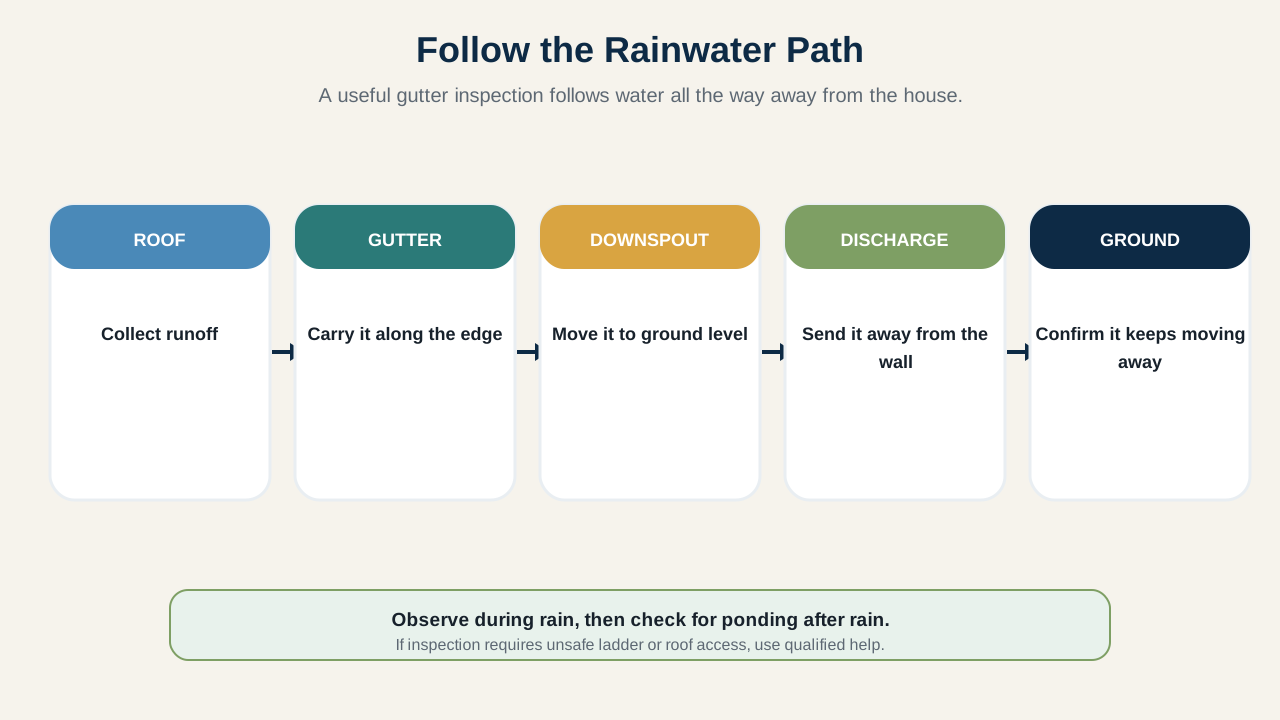
Think of the System as a Water Path
A gutter problem is not only a gutter problem.
Rainwater follows a path:
Roof → gutter → downspout → extension or drain → final discharge area
A failure anywhere along that path can move water somewhere you did not intend.
Examples:
- the gutter is clogged, so water spills over the edge;
- the downspout is disconnected, so roof runoff lands at the wall;
- the downspout is clear but ends beside the foundation;
- an underground leader is blocked, so water backs up;
- the discharge point works, but the ground slopes back toward the house.
So checking only the gutter opening isn’t enough.
Follow the whole path.
Start With a Ground-Level Walkaround
Choose a dry day first.
Walk around the house and look up from the ground.
You may be able to see:
- gutters that sag between hangers;
- sections pulling away from the fascia;
- downspouts that are disconnected;
- missing elbows or extensions;
- crushed lower downspout sections;
- vegetation or visible debris at outlets;
- staining on siding below gutter joints;
- erosion where water repeatedly discharges;
- splash marks on foundation walls;
- low spots where water appears likely to collect.
Do not stand on furniture, improvised platforms, vehicle roofs, railings, or unstable objects to gain a better view.
If the condition cannot be evaluated from safe ground access, that is information in itself: the next step may require professional inspection or properly planned ladder work by someone equipped and competent to do it safely.
Observe the System During Rain
A dry inspection tells you about condition.
Rain tells you about performance.
During an ordinary rain event, observe from a safe location.
Look for:
- water flowing over the front or back of a gutter;
- a section that drains much more slowly than the rest;
- water leaking from joints;
- a downspout that appears to receive little or no flow while the gutter is overflowing;
- water spraying from a disconnected connection;
- discharge collecting beside the foundation;
- water running back toward the house.
Do not go onto a roof or climb a wet ladder during rain to inspect more closely.
Wet surfaces, wind, and rushing to correct a leak make access more dangerous.
Observe first. Repair later under safe conditions.
Overflow Usually Means the Water Path Is Restricted or Overwhelmed
If water is pouring over a gutter edge, several explanations remain possible.
The gutter may contain debris.
A downspout may be clogged.
The gutter may be sagging or pitched incorrectly.
A connection may be blocked.
Or the rainfall may simply exceed what the system can handle.
Do not diagnose the exact cause from one overflow location unless you can verify it.
Document where the overflow occurs and what the downstream components are doing.
A recurring overflow at the same place is more useful evidence than a vague memory that “the gutters leak.”
Check Every Downspout Connection
A downspout cannot protect the foundation if it is not connected to the gutter above or the discharge path below.
Walk each downspout from top to bottom visually where possible.
Look for:
- separated elbows;
- missing fasteners;
- crushed sections;
- holes or split seams;
- disconnected extensions;
- an outlet blocked by mulch, soil, leaves, or stored items.
EPA moisture guidance includes disconnected downspouts as a clear example of roof water being deposited near the foundation.
A simple reconnection may be obvious, but do not assume that every underground or concealed connection is functioning just because the visible pipe looks intact.
Where the Downspout Ends Matters
The outlet is one of the most important parts of the system.
DOE building-science guidance explains why: a large volume of roof runoff dumped beside the house can rapidly saturate the soil around the foundation and contribute to moisture problems.
DOE examples commonly route above-grade downspout discharge to a sloping final grade at least several feet from the foundation, with some technical guidance using 5 feet for above-grade discharge and longer distances for certain underground systems.
EPA technical moisture guidance also contains project-specific drainage distances and slopes.
These are useful design references, not permission to impose one number on every existing property.
Local code, lot size, easements, neighboring property, sidewalks, soil conditions, stormwater rules, and the design of an underground drainage system can all change what is appropriate.
The homeowner question is simpler:
Does the discharge actually move water away from the house without creating a new problem somewhere else?
Look at the Ground After Rain
After the rain stops, walk the perimeter again.
Look for:
- puddles touching the foundation;
- saturated mulch or soil beside a wall;
- erosion channels;
- washed-out landscaping;
- water collecting near basement windows;
- wet crawlspace or basement areas that correspond with exterior drainage problems;
- staining where roof runoff repeatedly splashes against the building.
FEMA recommends improving drainage where stormwater accumulates around the home, and EPA moisture guidance emphasizes grading that carries surface water away from foundation walls.
This is where the gutter inspection connects with the foundation-drainage article.
The gutter can be perfectly clear and still deliver water to a bad discharge location.
What About Underground Downspout Drains?
Some homes connect downspouts to underground leaders or catchment systems.
You may not be able to see whether that system is open.
EPA guidance for remodeling and moisture control recommends testing underground drains with water to confirm they function, while DOE guidance emphasizes proper final discharge and separation from foundation-drain systems in applicable assemblies.
A homeowner should be careful here.
Do not force large volumes of water into a buried line if you do not know where it goes, whether it is damaged, or whether local rules allow the connection.
If an underground system backs up, overflows near the foundation, or has an unknown outlet, consider a drainage professional who can identify and evaluate the line.
Clean Gutters Routinely, but Do Not Create a Fall Hazard
FEMA’s homeowner guidance is direct: routinely clean and maintain gutters and downspouts.
The cleaning method depends on access.
A one-story gutter that can be serviced with an appropriate ground-based tool is a different risk from a steep two-story roofline over hard pavement.
This site does not provide ladder or roof-climbing instructions because the consequence of a fall can be severe and the correct equipment and setup depend on the building.
If you cannot clean the system from a safe position using a tool intended for that purpose, hire a qualified gutter or exterior-maintenance contractor.
The goal is a functioning drainage system, not proving that every homeowner should access every gutter personally.
Gutter Guards Do Not Eliminate Inspection
A cover or guard can reduce some debris entry, but it does not make the drainage system maintenance-free.
Debris can collect on top of guards, at valleys, in downspouts, or at outlet points.
Sections can still loosen or leak.
A guarded gutter still needs performance observation.
During rain, look for whether water enters the gutter rather than overshooting or cascading over the edge.
After rain, confirm the downspout still sends the runoff where it should go.
Do not treat the presence of a guard as proof that the system is clear.
Snow and Ice Change the Pattern
In colder climates, FEMA winter-preparedness guidance tells homeowners to keep gutters clear so melting snow can drain properly and notes that clogged gutters can contribute to problems such as ice dams and roof leaks.
That does not mean every ice dam is caused by a dirty gutter.
Attic air leakage, insulation, roof temperature, weather, and roof geometry can also contribute.
If winter ice repeatedly forms at the eaves, do not assume gutter cleaning alone is the complete diagnosis.
The attic-insulation and air-sealing guides are relevant when the pattern points beyond drainage.
A Gutter and Downspout Decision Table
| What you find | What it suggests | What to do next |
|---|---|---|
| Water flows through gutters and exits away from foundation | Drainage path is functioning during that event | Continue routine observation and maintenance |
| Water spills over one gutter section | Debris, downspout restriction, pitch, or capacity issue is possible | Inspect/clean safely or use a contractor |
| Downspout is disconnected | Roof runoff is not following the intended path | Reconnect or repair appropriately |
| Outlet is buried in leaves or mulch | Discharge may be restricted | Clear the outlet from safe ground access |
| Water exits directly beside foundation | Soil saturation risk is higher | Improve the discharge path consistent with local conditions |
| Puddle remains beside foundation after rain | Grading or drainage problem may remain | Evaluate the broader foundation-drainage path |
| Underground leader backs up | Buried line may be restricted or damaged | Identify the system; consider drainage professional |
| Gutter is visibly pulling away from fascia | Structural attachment needs repair | Avoid loading the gutter; arrange repair |
| Inspection requires wet ladder or roof access | Fall risk exceeds routine observation | Wait for safe conditions/use qualified service |
| Basement dampness appears after rain | Exterior water management may be involved | Compare timing with gutters, grading, and foundation drainage |
Do Not Send the Water Toward Someone Else
Moving a downspout farther from your foundation is not automatically a good solution if it discharges onto a neighbor’s property, across a walkway, into an unsafe area, or somewhere prohibited by local stormwater rules.
The final discharge has to work for the site.
Before making a major drainage change, check local requirements and understand where the water will go during a real storm.
If the lot is tight or the solution involves underground drainage, dry wells, grading, or connection to a storm system, professional design may be worthwhile.
When to Escalate
Use professional help when:
- gutters are high or difficult to access safely;
- sections are detached or structurally damaged;
- fascia or roof-edge materials appear rotted;
- repeated overflow continues after basic maintenance;
- buried drainage is blocked or its outlet is unknown;
- large grading changes are needed;
- runoff repeatedly reaches the basement or crawlspace;
- the repair would require roof access you cannot perform safely.
This is the same DIY-or-hire boundary used elsewhere on the site: safe access and verifiable results matter more than whether the task sounds simple.
Build a Rainwater Baseline
You can learn more about exterior drainage during one ordinary rainstorm than during months of dry weather.
Document:
- where each downspout ends;
- which gutters overflow;
- where water ponds after rain;
- any staining on siding or foundation;
- basement or crawlspace dampness that appears after storms;
- repairs and cleaning dates;
- photos before and after drainage changes.
That record makes future troubleshooting much faster.
If water later appears in the basement, you already know whether a nearby downspout was overflowing or dumping beside the wall.
Follow the Water All the Way Away From the House
The useful gutter inspection does not stop at the roof edge.
It follows the entire path:
Roof → gutter → downspout → discharge → ground → foundation response
Keep the system clear, connected, and directing water away from the building.
Observe it during rain.
Then inspect the ground afterward.
If the only way to continue the inspection is unsafe ladder or roof access, stop there and use qualified help.
The objective is not to get closer to the gutter.
It is to know whether the house is managing rainwater before the next heavy storm proves that it is not.
This check is one part of a broader moisture and water approach to home maintenance, and it pairs naturally with checking drainage around your foundation and testing your sump pump before heavy rain: gutters and grading on the outside, the sump system on the inside. If the moisture pattern you’re seeing is indoors rather than at the foundation, condensation or a possible leak walks through separating that from a rain-related source, and the first-time homeowner maintenance checklist covers the broader seasonal routine this check fits into.
Sources and further reading
We prioritize primary and authoritative sources. The sources below support the factual and technical guidance used in this article.
- Federal Emergency Management Agency: Protect Your Home From Flooding
- U.S. Department of Energy (Building Science Education / BSESC): Stormwater: Gutters and Downspouts
- U.S. Department of Energy (Building Science Education / BSESC): Foundation Drain: Gutters and Downspouts
- U.S. Environmental Protection Agency: Addressing Indoor Environmental Concerns During Remodeling
- U.S. Environmental Protection Agency: What are the main ways to control moisture in your home?
- Federal Emergency Management Agency: Winterizing Your Home
Practical Homeownership provides general educational guidance. Home conditions, local rules, manufacturer requirements, and the appropriate professional scope can vary.