Smoke and Carbon Monoxide Alarms: What Homeowners Should Check, Where They Go, and When to Replace Them

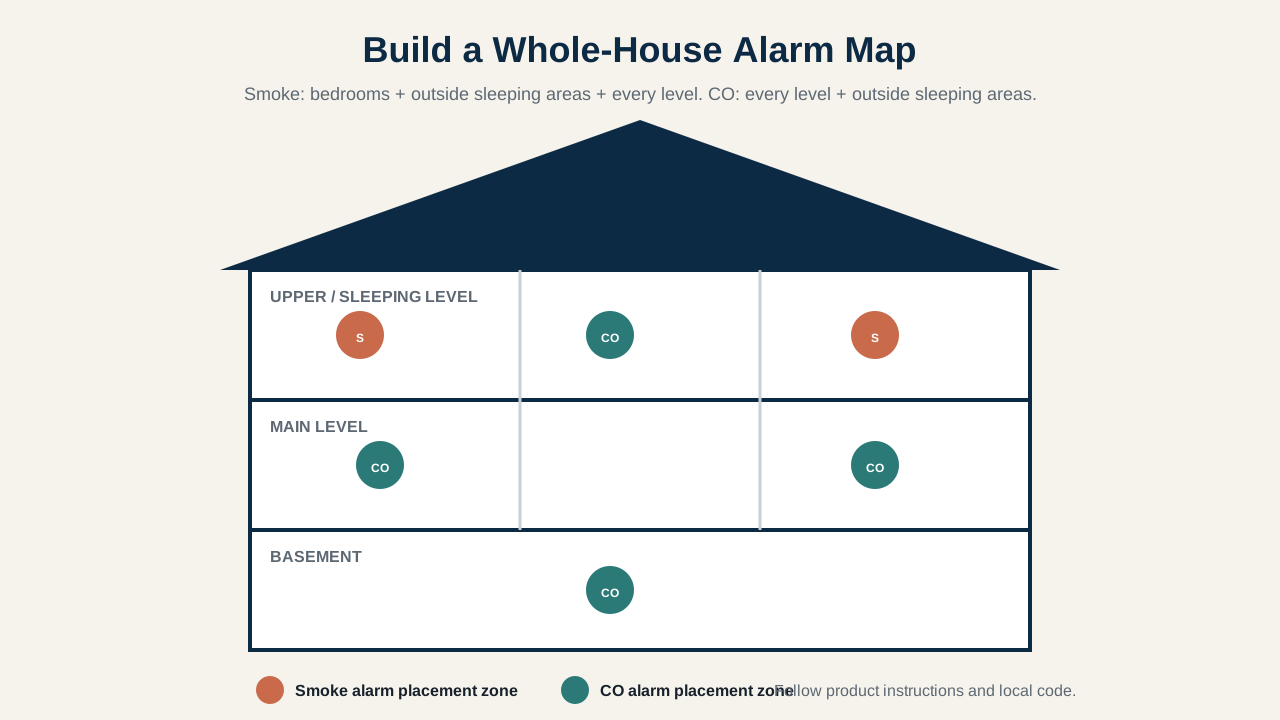
Install smoke alarms inside every bedroom, outside sleeping areas, and on every level of the home including the basement; install CO alarms on every level and outside sleeping areas; test both monthly and replace smoke alarms 10 years from the manufacture date.
Smoke alarms and carbon monoxide alarms are easy to ignore precisely because most of the time they do nothing. They sit on a ceiling or wall for years, quietly becoming part of the background. That makes them different from many other home systems: you don’t get a comfort complaint, a puddle, or a strange noise every time maintenance is overdue. The first sign of a failed alarm may arrive at the exact moment you needed it to work.
A first-time homeowner should treat alarms as a system to audit, not just devices to notice. You need to know whether you have enough coverage, whether the alarms are in the right places, whether they actually test, how they’re powered, how old they are, and what you’re supposed to do when one sounds.
The short answer
For smoke alarms, the U.S. Fire Administration recommends alarms inside every bedroom, outside each separate sleeping area, and on every level of the home, including the basement. Smoke alarms should be tested monthly and replaced after 10 years from the manufacture date.
For carbon monoxide alarms, CPSC and the U.S. Fire Administration recommend alarms on every level of the home and outside sleeping areas. Test them monthly and replace the alarm according to the manufacturer’s recommended service life or end-of-life signal.
Interconnected alarms provide stronger warning, because when one sounds, the others sound as well. Hardwired smoke-alarm installation should be handled by a qualified electrician. Local building and fire codes can add requirements, so the manufacturer’s instructions and your local rules still matter.
Smoke and Carbon Monoxide Are Different Hazards
Smoke alarms and CO alarms are often sold together, but they’re not detecting the same thing. A smoke alarm is intended to warn you about products of a fire. A carbon monoxide alarm is intended to warn you about CO, a colorless and odorless poisonous gas that can be produced when fuel-burning equipment is operating or venting improperly, and you can’t rely on smell to detect it. The same is true of radon, another invisible hazard that needs its own testing routine rather than an alarm you can see or hear. That’s why a house may need both types of protection even if the devices look similar.
Combination smoke-and-CO alarms are available, but the combined device still has to satisfy the placement and maintenance needs for both hazards.
Start With a Whole-House Alarm Map
Don’t begin by pressing random test buttons. First, walk the house and make a simple map of what’s installed. For each alarm, record its location; whether it’s smoke, CO, or combination; its power source (battery, sealed battery, plug-in, or hardwired); the manufacturer and model if visible; the manufacture date; the replacement or end-of-life date if listed; and whether it appears to be interconnected.
You’re trying to answer a basic question: does this house have a complete alarm system, or just a collection of devices? That distinction becomes obvious once you map the coverage.
Where Smoke Alarms Should Go
USFA recommends smoke alarms inside every bedroom, outside each separate sleeping area, and on every level of the home, including the basement. USFA also recommends interconnected alarms so that when one sounds, they all sound.
Placement within a room matters too. Smoke alarms are generally mounted on the ceiling or high on a wall, but the manufacturer’s instructions should control the exact placement for the specific alarm, and local fire codes may also require a particular type or arrangement.
If you discover that your house has a single smoke alarm in a hallway and nothing in the bedrooms or on another floor, the issue isn’t whether that one alarm still beeps. The coverage itself needs attention.
What Type of Smoke Alarm Should You Use?
Residential smoke alarms commonly use two sensing technologies: ionization and photoelectric. USFA explains that ionization alarms tend to respond faster to flaming fires, while photoelectric alarms tend to respond faster to smoldering fires. Because no homeowner can predict what type of fire will occur, USFA recommends either having both ionization and photoelectric smoke alarms, or using dual-sensor smoke alarms that include both technologies. USFA doesn’t say one sensing technology is universally better than the other, which is another reason not to reduce the purchase decision to whichever alarm is cheapest or looks newest.
Check local requirements too: your city, county, or state may specify the type of alarm required in your home.
Where Carbon Monoxide Alarms Should Go
CPSC recommends CO alarms on every level of the home and outside sleeping areas; USFA gives the same core placement guidance. Follow the alarm manufacturer’s instructions for exact mounting location. Don’t assume a CO alarm needs to sit directly next to a furnace, fireplace, or other fuel-burning appliance. CPSC guidance says to follow the product instructions and avoid placements that interfere with proper operation.
The purpose of the alarm is to provide effective warning to occupants, especially around sleeping areas. If you’re unsure whether your existing locations satisfy current requirements, check the product instructions and your local fire or building authority.
Test Every Alarm Monthly
Both USFA and CPSC recommend monthly testing. Use the alarm’s test button and follow the manufacturer’s instructions. A successful test tells you that the alarm’s test circuitry and audible warning are functioning.
For CO alarms, CPSC specifically notes that pressing the test button checks the circuitry; it does not prove the sensor’s measurement accuracy. That distinction matters because homeowners sometimes treat a successful beep as proof that an old CO sensor is still within its intended service life. It isn’t. Testing and replacement age are two separate checks. The same distinction between “the test worked” and “the protection is real” comes up with testing a GFCI outlet: a powered outlet doesn’t prove the ground-fault protection is functioning any more than a beeping alarm proves the CO sensor is accurate.
Age Matters Even When the Alarm Still Beeps
Smoke alarms. USFA recommends replacing smoke alarms 10 years from the manufacture date, which is usually printed on the alarm. If you moved into a house with alarms already installed, the purchase date isn’t what matters, since you may not know it. Check the manufacture date instead. An alarm can still respond to the test button and still be old enough to replace.
Carbon monoxide alarms. CO alarms don’t all share one universal replacement age. CPSC advises consumers to follow the product literature or manufacturer’s recommended replacement age; newer CO alarms may provide an end-of-life signal telling you when the unit needs replacement. That means the homeowner audit should record the specific model and its replacement instructions rather than assuming every CO alarm lasts ten years.
Batteries: Know What Kind of Alarm You Have
A battery-powered alarm may use a replaceable battery or a sealed long-life battery. A hardwired alarm usually still has backup power. USFA’s general guidance for smoke alarms includes testing monthly, replacing ordinary replaceable batteries at least yearly, and replacing the entire smoke alarm every 10 years. For sealed long-life smoke alarms, don’t try to open a battery compartment that wasn’t designed for routine battery replacement. Follow the manufacturer’s replacement instructions instead. CPSC similarly advises annual battery replacement for alarms with replaceable batteries, along with monthly testing.
The simplest homeowner rule: don’t treat every alarm as if it has the same battery system. Read the label.
A Quick Alarm Audit Table
| What you find | Why it matters | What to do |
|---|---|---|
| Smoke alarm missing from a bedroom | Coverage does not match USFA guidance | Add appropriate coverage according to manufacturer and local requirements |
| No smoke alarm on one level of the house | A fire may start far from the existing alarm | Correct the coverage gap |
| No CO alarm outside sleeping areas | Occupants may not receive adequate warning while asleep | Add CO coverage according to manufacturer/local requirements |
| Smoke alarm is 10+ years from manufacture | USFA replacement age has been reached | Replace the alarm |
| CO alarm is at or beyond its listed service life | Sensor is beyond intended replacement age | Replace according to manufacturer guidance |
| Alarm does not respond to monthly test | Warning function cannot be relied upon | Follow manufacturer troubleshooting/replacement guidance immediately |
| Hardwired alarm needs installation or wiring work | Electrical work is involved | Use a qualified electrician |
| Frequent nuisance alarms near cooking or steam | Disabling the alarm creates a safety gap | Follow manufacturer/USFA placement and hush guidance instead of removing protection |
| Household member may not hear a standard alarm | Audible warning may not be sufficient | Consider listed alert devices designed for hearing loss |
Do Not Disable an Alarm Because It’s Annoying
Cooking and steam can trigger nuisance alarms, and that’s frustrating, but removing the battery or disabling the alarm trades an inconvenience for a safety failure. USFA specifically warns homeowners not to remove a smoke-alarm battery because the alarm sounds during cooking. Instead, use the alarm’s hush feature if provided, improve ventilation, and follow manufacturer guidance about acceptable placement.
If the alarm has clearly been installed too close to a recurring nuisance source, correct the installation rather than living with an alarm everyone learns to ignore. A safety device that people routinely disable isn’t a functioning safety system.
Interconnection Changes the Warning
An alarm detects a hazard where the sensor is located; interconnection helps spread that warning through the home. USFA recommends interconnected smoke alarms, and CPSC also says interconnected CO alarms are best, because when one sounds, they all sound. This matters in larger or multilevel homes where a hazard can begin far from sleeping occupants.
Interconnection can be hardwired or supported by listed wireless alarm systems, depending on the product and local code. Don’t improvise interconnection between incompatible devices. Use systems intended to work together and follow the manufacturer’s instructions.
What to Do When an Alarm Sounds
Maintenance is only half of the system. The other half is knowing the response.
If a smoke alarm sounds, treat it as a fire warning. Get everyone out and follow your home fire-escape plan. Don’t spend time investigating the source if doing so delays evacuation. USFA warns that once a smoke alarm sounds, occupants may have very little time to escape. A working alarm is intended to buy warning time. Use it.
If a CO alarm sounds, or you suspect CO poisoning, CPSC says to get outside to fresh air immediately and call 911 if you suspect carbon monoxide poisoning. Possible symptoms include headache, dizziness, weakness, nausea, vomiting, sleepiness, and confusion. Don’t remain inside trying to find the source. Fuel-burning appliances, generators, vehicles, and other combustion equipment can produce dangerous CO conditions. The alarm response is an evacuation decision first, not a homeowner diagnostic exercise.
Do Not Use the Alarm to Make Unsafe Equipment “Acceptable”
A CO alarm is a layer of protection. It’s not permission to use combustion equipment in an unsafe way. CPSC warns never to use portable generators inside homes or garages, even with doors and windows open. Generators should be outside and away from the home according to current safety guidance. Likewise, a CO alarm doesn’t replace correct venting, installation, inspection, and maintenance of fuel-burning equipment, just as a smoke alarm doesn’t make unsafe electrical work acceptable. A gas-fired water heater is a good example of that kind of equipment: a visual water heater inspection covers the observation-only checks a homeowner can safely do, but combustion, venting, and gas connections still belong to a qualified professional, alarm or no alarm. Safety alarms are the last warning layer, not the first maintenance strategy.
Hardwired Alarms Cross Into Electrical Work
A homeowner can press the test button on a hardwired alarm and replace an approved backup battery when the manufacturer provides for that maintenance. Installing or altering the hardwired electrical connection is different. USFA says only qualified electricians should install hardwired smoke alarms. If you’re replacing a hardwired unit, adding interconnection wiring, moving an electrical box, or changing household wiring, treat that as electrical work rather than ordinary alarm maintenance.
This is a good example of the DIY-or-professional boundary: the plastic alarm itself may look simple, but the system behind it is what changes the risk.
Your First-Time Homeowner Alarm Baseline
During your first month in a house, build an alarm record.
Step 1: Map every device. Walk every level and every sleeping area. Record what’s present and what appears to be missing.
Step 2: Identify the device. Smoke, CO, or combination. Record the manufacturer and model when possible.
Step 3: Check the manufacture date. Don’t guess from the color of the plastic or how clean the alarm looks.
Step 4: Test every alarm. Use the manufacturer’s test procedure.
Step 5: Record the power source. Replaceable battery, sealed battery, plug-in, hardwired, or combination.
Step 6: Check interconnection. Know whether one alarm activates the others.
Step 7: Correct gaps. Use manufacturer instructions and local requirements. If hardwired electrical work is required, use a qualified electrician.
Step 8: Put monthly testing on the calendar. Don’t depend on memory. The same monthly habit is worth extending to the GFCI outlets in your kitchen, bathrooms, and garage. See how to test a GFCI outlet for that routine.
This turns alarm maintenance into a repeatable system. The same repeatable-system approach applies to other home-safety tasks with their own schedule, like the dryer-vent maintenance routine.
Local Requirements Still Matter
Fire and building codes are adopted and enforced locally, and a federal safety recommendation isn’t a substitute for checking what your jurisdiction requires. Local rules may affect alarm type, locations, interconnection, hardwiring, battery requirements, and requirements triggered by renovation, sale, or rental.
USFA specifically advises consumers to check with the local fire marshal when local rules may dictate the required alarm type. The safest editorial rule is simple: use federal guidance as your safety baseline, then verify the requirements where your home is located.
The Alarm System Should Be Boring Because You Maintain It
You don’t want smoke and CO alarms to become interesting. You want them mapped, correctly located, current, tested, and easy to forget until the next scheduled check. A good alarm routine follows five steps: coverage, power, test, age, response.
Coverage tells you whether the house is protected where people sleep and live. Power tells you what maintenance the alarm requires. Testing tells you whether the warning function responds. Age tells you whether the device has reached replacement time. Response tells everyone in the house what happens when the alarm is no longer quiet.
Do that audit once when you move in, then maintain it. It’s one of the highest-consequence home systems you can understand without taking anything apart.
The same maintenance mindset applies to checking your home fire extinguisher: confirm it’s accessible, correctly rated, and ready before you ever need it.
This alarm audit is one part of a larger indoor air and safety approach to home maintenance: map what’s installed, correct gaps against manufacturer and local requirements, and keep testing on a monthly schedule.
Sources and further reading
We prioritize primary and authoritative sources. The sources below support the factual and technical guidance used in this article.
Practical Homeownership provides general educational guidance. Home conditions, local rules, manufacturer requirements, and the appropriate professional scope can vary.